Training

All things training. Mostly advice and tips but maybe questions, general comments, or who knows what else.

Find a coach who cares

This article was originally posted by Ryan at the original HillRunner.com Blogs.

Image

"People don’t care how much you know until they know how much you care." – John Wooden

Recently, I received a request from someone who wanted me to coach her daughter. In the end, I had to say no. I won’t get into the details but it just wasn’t a good fit. I didn’t feel like my working with this individual would have been in her best interest. More than picking up another client, I wanted to see her do her best. Even in declining to coach her, I cared about her as a runner and as a person and wanted to see her get what was best for her. It’s always hard to turn someone down but sometimes it’s in their best interest.

I don’t often write about the topic of coaching or coaches on the blog because I’m afraid people might get the impression that I’m interested in self promotion. That’s not what this is about. It’s just a statement of what I believe is the most important aspect of being a coach and, if you are thinking of getting a coach, one thing I truly hope you will think a lot about before hiring anyone.

If your coach doesn’t care for you, is your coach going to invest enough of him/herself to really help you get the most out of your running? Is your coach going to give enough attention to the details of your personal life that make you different from every other runner in the world and build your training plan to work around that life? Is your coach going to be paying enough attention to adjust that plan as unforeseen circumstances present themselves? Is your coach going to be personally invested in your success?

If not, what are you paying for?

There are many coaches out there. There are varying degrees of knowledge, from those who are true masters of the sport to those who have only been involved in the sport for a few years. As important as it is to pick someone who has deep and broad knowledge of the sport and how to succeed in it, it’s also important to pick someone who is going to care about you as an individual and is going to be personally invested in you. There are coaches out there who meet both qualifications. If you’re looking to hire a coach, make sure you’re picking one of them.

Find a coach who cares Read More »

Staying upright in winter weather: running strategies

This article was originally posted by Ryan at the original HillRunner.com Blogs.

Image

You’re out running on a beautiful winter day. Gentle snow falling, a fresh blanket of snow over everything. You planned ahead and have your trail shoes, Yaktrax, screw shoes or whatever other device you decided necessary. Still, while beautiful to see, the fresh blanket of snow leaves your footing questionable at best. Now, what do you do?

Traction devices aren’t always enough. Worse yet, we don’t always get what we planned for and we can be caught without what would be best for the conditions we’re running in. So we need strategies for running when our footing isn’t the best. Here are a few strategies I’ve found useful after 20 Wisconsin winters.

As most people from wintery climates know from walking in the conditions, the key to staying upright is keeping your center of gravity over your feet. I’ve heard the philosophy of "walk like a penguin" several times over the last few years. The problem for runners is penguins don’t run real fast for a reason.

Still, we can carry over lessons from the penguins. The idea of keeping your center of gravity (more) directly over your feet still applies. Shortening your stride and keeping your feet more directly under you is the most important step you can take. This means you might not be able to run with that wide open, graceful stride you would like to. You need to become a shuffler. Just remember, it’s better than not running at all and you can use it to practice a quick turnover.

Once you get that short, quick stride down, you have running straight at a steady speed mostly taken care of. Next, you have to worry about changing speed and going around corners. When it comes to these things, the simple rule is nothing sudden. There are times when I come to nearly a complete stop to take turns. There are times when I begin slowing down several yards before I need to come to a stop. On downhills, I might start slowing 10-20 yards early or even more. Again, this is just what we have to do in some conditions. These things may break up our runs a bit but they are better than not running and they are better than falling and getting hurt.

There are times when you just know you’re going to slip. Those patches of glare ice where melting snow runs across the sidewalk or similar obstacles are just waiting for us out there. No matter what we do, we’re going to slip. In these cases, it can be better to take a controlled slide than try to run across and lose your footing. I remember one person I ran with a few times who said I would "surf the ice" to get across particularly bad patches. I would essentially get a wide stance, get my arms out for balance and just slide across the patch of ice. This was my strategy for getting across particularly bad patches and it has saved me from quite a few sure falls.

So what do you do if all the advice above doesn’t work and you do fall? I’ve run through 20 Wisconsin winters. Only once did I go through a whole winter without at least one fall, which means maybe all the above advice should be taken with a grain of salt and commenters will have advice that I should be following. Unfortunately, when we do fall, it happens so quickly that we usually respond instinctively. If you can temper your instincts in that split second you have, don’t try to catch yourself. This is often how people get hurt. The best strategy I’ve found is to just tuck and roll or tuck and slide.

Finally, the treadmill is not your enemy. If the conditions are bad and the treadmill is an option, don’t hesitate to use it. The good news for most of us is that slippery conditions typically only last a day or two. Roads and sidewalks will be cleared, we’ll be back to sure footing and you can head back outside without fear of falling.

What do you think? I know there are people reading this who have a lot of experience running through winter weather. What tips do you have to stay upright while running?

Staying upright in winter weather: running strategies Read More »

Staying upright in winter weather: traction devices

This article was originally posted by Ryan at the original HillRunner.com Blogs.

Image

After my winter running post last week, I saw a few interesting topics/questions come up on winter running so I’d like to delve a little deeper into a few topics. First, tools to help keep traction while running through the winter.

First things first, there are times when nothing will give you great traction. At these times, you may need to adjust your running. Take short, quick steps, keeping your feet closer to directly under your center of gravity. Slow down – a lot – and even stop to walk if necessary. Especially when changing direction. I will possibly write more about this later. That said, what we put on our feet can improve our chances of keeping our feet under us in bad conditions.

The second thing to note is that different methods work in different conditions. Snow and ice can both present problems and what works best for one may help for the other but what is best for one may not be best for the other. On that note, here are my suggestions for both snow and ice.

Snow

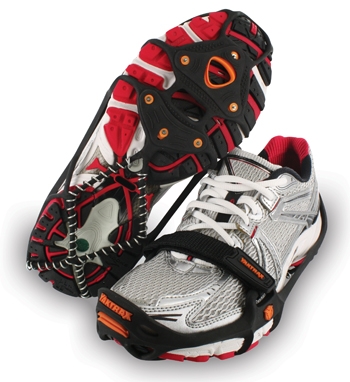
The main problem when running in snow is that most road running shoes don’t have enough tread to get down into the snow and get some grip. The best solution I’ve found for this is to get a pair of trail shoes that have an aggressive tread pattern. For those of you who like minimal shoes, look into cross country flats. These shoes are basically like snow tires for your car. The treads will get down into the snow and give you a better grip. Devices like Yaktrax (I’ll discuss them more later when discussing ice) might help because the coils and spikes will play the role of the tread that gets deeper into the snow but, in my experience, the tread of trail shoes or cross country flats works as well as anything.

If you’re running in good packing snow, you might find the snow clumping up in your treads and reducing your traction. Trail shoes and cross country flats are usually pretty good at shedding snow but there is some snow that is just too stubborn and you need some help. An old trick from high school and collegiate cross country teams is to spray the bottom of your shoes with non-stick cooking spray. Just as the spray will help keep your food from sticking to your pans when baking, it will help keep the snow from sticking to your shoes while running.

Ice

The main problem when running on ice is different. No amount of rubber is going to penetrate the smooth, hard surface. If the ice is pitted, the tread on trail shoes or cross country flats may help but it won’t be a cure all. If the ice is smooth, the trail shoes or cross country flats may be useless. So we need to look elsewhere. In short, we need to add sharp metal edges that will chip into the ice, giving us some traction.

There are several methods for doing this. I already mentioned Yaktrax, also pictured at the top. I question the value of the coils on smooth ice but the spikes in the picture above would work well. There are other similar products but Yaktrax are the most popular for runners and, with the strap that goes over the top of the foot, seems like the most sure to stay in place while running.

If you’re a minimalist runner, you might consider cross country spikes. With these, you get a nice combination of the tread to help with snow and, to some extent, on pitted ice plus metal spikes to help with ice. I’ve been using these with a lot of success over the past two winters and my only complaint is that I didn’t think of this sooner.

If you’re concerned about prices, there is another option that I used for years before trying cross country spikes. This would be the screw shoe. I know, this sounds absolutely crazy. Most shoes, though, have a pretty thick midsole that can allow you to use at least a 1/4 or 3/8 inch screw with no problem. Get the screws into the rubber soles of your shoes, don’t over tighten, and it takes a lot to have them fall out. Just be aware of how thick your soles are, especially if you’re a minimalist. If you’re using shoes with air or gel pockets, you also have to be cautious about placement so you don’t penetrate the pockets. Sheet metal screws work very well. The lip on the head is great for cutting into the ice to get traction.

In the end, all three of these options (Yaktrax or a similar product, cross country spikes or screw shoes) do the same thing. They get metal on the ice. If the metal can chip into the ice, you get improved traction. Not perfect traction. You still need to be careful. However, you can run with more confidence and fewer problems on ice with these than without.

Beware of cars!

One final piece of safety advice I want to mention. You can do things to help yourself keep traction but always think of others. If you’re running on roads that you have to share with cars, consider the traction they will have. What happens if a driver overreacts to your presence and oversteers or brakes too hard? What happens if someone is going too fast for the conditions and simply loses control? Do you have a safe escape route? How do people drive on the roads you run on? Do they drive slowly, safely and cautiously, especially in bad conditions? Or do they drive fast even in bad conditions? Keeping your feet under you is of limited benefit if you have a few tons of steel sliding out of control toward you at 50 miles per hour.


Staying upright in winter weather: traction devices Read More »

The power of positive self talk

This article was originally posted by Ryan at the original HillRunner.com Blogs.

I’ve been thinking a lot lately about the mental aspect of running. As some of the runners I coach know, I’ve been exploring ideas of how I can introduce mental aspects into an online coaching setting. Here is a good idea of how that might be done.

In short, in the study discussed, pre-planned and well practiced positive self talk appears to have helped athletes push harder while feeling the effort was less difficult.

What can we take from this? Well, this study reminded me of mantras that every coach I’ve had has encouraged and I’ve recommended at various times to runners. In the past, I thought of good mantras being anything from positive self talk to reminders to run tall or keep a quick turnover. While the reminders obviously are helpful as they can keep us focused on good habits, I always believed in the positive self talk but never really could say how it worked. Now, we have some data that shows that it works by lowering your perceived exertion.

This also plays into the idea that performance is limited by, to use a Tim Noakes term, a "central governor" as opposed to pure physiological constraints. I still think the physiological constraints are important. If your "central governor" shuts you down at 90% of capacity (just a hypothetical number) increasing your overall capacity will also increase that 90% threshold. That said, for a little extra boost, if positive self talk allows you to push to 91% or 92% of capacity, then you can perform at an even higher level given the same fitness.

The power of positive self talk Read More »

Elite Diet?

This article was originally posted by Ed at the original HillRunner.com Blogs.

I am looking for an edge to make better improvements in my speed and endurance. I refuse to use caffeine or other stimulants (even if natural) to help give a boost. I wondered what diet the amazing Kenyan’s ate or even other elite runners. Some of what the Kenyan diet consists of seems to go against the grain of current dietary health trends in the US. I am going to explore other elite runner diet habits and begin to adapt some from each. I know I will have to find what I can afford, what other members of my family can tolerate as well as what will work for me. Should be a good challenge. Here is a good article about a typical elite Kenyan runner’s diet.

https://www.active.com/running/articles/eating-practices-of-the-best-endurance-athletes-in-the-world?page=1

Elite Diet? Read More »

Scroll to Top