
Training capacity: other considerations

This article was originally posted by Ryan at the original HillRunner.com Blogs.

Over the past two weeks, I went over how to define training capacity and how to find your training capacity, as well as what to do when you’ve found it.

This is the part 3 of a 3 part series on training capacity:

1) What is training capacity?

2) How to find your training capacity and what to do when you have found it?

3) Other training capacity considerations.

This week, in the final post in this series on training capacity, I want to discuss other considerations. Mainly:

1) Physical AND mental

2) Outside stresses

3) Your training capacity can and WILL change (don’t forget to address age)

4) Sometimes you’ll miss – adjust and move on

Training capacity is determined by physical AND mental capacity

We often think of the physical aspect. My body is breaking down, I must have gone beyond my capacity. My body is holding up, I’m doing fine.

That’s not all there is, though. How is your motivation? It doesn’t help at all if your body is holding up fine but you’re dragging mentally. I’ve seen it numerous times and you probably have seen it at least occasionally also if you think about it. A runner is running well, all is going right. Then, for apparently no reason to the outside world, the runner disappears. When the runner reappears, you find out there were no physical problems. Instead, the runner just lost interest.

Just as with physical capacity, our mental capacity plays a critical role. Just as with physical capacity, you can do things to increase your mental capacity but your starting point is no reflection on you as a runner. Some of us are easily highly motivated and will push through a grueling workload, others don’t have that motivation and need ways to keep things fresh and fun. Where you fall in that spectrum might affect your ultimate potential at the edges but it doesn’t have to predetermine your life as a runner.

Outside stresses play an important role

Are you facing an especially stressful time in your work or home life? This will affect your training capacity. If you don’t account for that, you will pay the price. Don’t be afraid to cut back some when stresses outside of running build up.

Running is a great release for many of us when we face stressful times but training at your capacity is also a stressor of its own type. Your body is only capable of handling so much stress at any given time. When one stress increases, another has to be decreased. The good news is that, when your outside stresses fade back down, you can increase your training load again.

Your training capacity can and WILL change

Our training capacities are always changing. As we gain fitness, we’re becoming more capable of handling a larger training load. If we lose fitness, our training capacity decreases. As we age, our training capacity is affected

To account for this, always pay attention to how you’re feeling and continue to reassess where your current capacity is. When you are gaining fitness and your capacity is on the rise, though, don’t be constantly increasing the load. It’s too easy to go too far if you do that. I like the idea of adjusting your load upward about once every 3-4 weeks.

If your training capacity is decreasing, though, make the adjustments immediately. As I’ve already mentioned, you’re better off at 90% of capacity than at 110% of capacity.

As much as we don’t want it to happen, as we age, our training capacity also changes. For most runners, the best way to handle this is to adjust the amount of time between hard days or, as I’ve seen work well, to take one of the weekly hard days and lessen the intensity of it.

Sometimes you’ll miss – adjust and move on

Hitting your right training capacity is a tough balance. Plus, with your capacity always changing as mentioned above, sometimes you won’t adjust right as the change happens. It happens to all of us. When it happens, don’t make a big deal of it. Instead, find your way back to equilibrium, pay attention to find that right balance again and understand what changed and why so you can keep watching for the same or similar things to happen again and adjust before problems creep up next time.
Team HillRunner.com: 2014 Al’s Run important dates

This article was originally posted by Ryan at the original HillRunner.com Blogs.

Image

Teammates,

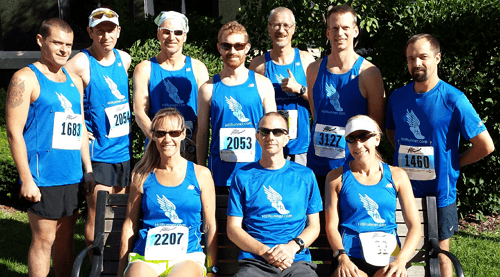
The time has come again! Most of you probably have already heard through some form of communication that team registration is open. We already have a strong team of 6 members registered. I’d love to see that hit at least 10 by the close of registration. Please see the important dates below so you register in time.

As usual, I will be inviting all team members to my house after the race. It’s a great chance to socialize with your teammates away from the race course.

Important Dates:

Tuesday, August 19th: I will again be offering a free singlet or t-shirt to everyone who runs on the team. This year, I will be adding long sleeve t-shirts. I would like to place the order on this date. Get registered and let me know what you would like by this date to make sure I have what you want.

Wednesday, August 27th: Our deadline for getting 10 runners on the team. It doesn’t look like I have to submit the team so we can still add runners to the team after this date but, if you want the HillRunner.com winged foot on the back of your shirt, you and at least 9 others need to be registered by 4pm on this date.

Saturday, September 13th: Race day!

Register as a member of Team HillRunner.com now!

Race report: 2014 Hank Aaron State Trail 5K

This article was originally posted by Ryan at the original HillRunner.com Blogs.

Every year, I tell myself I’m not going back to this race. Every year, it draws me back in. This year, I was going back and forth when Ed offered me a free entry if I run on the Potawatomi team. So I was back.

This course always frustrates me. I know by now it’s just a slow course and I’m running for place, not time. The field is also deep. Over the past several years, at my best I would struggle to get in the top 10. In recent years, top 20 or 25 would be the best I could hope for. So my goal was set. Top 25 finish and see if I could win my age group. I finished a close second in the age group last year.

As Ed and I warmed up, we realized how warm and humid it was. It hasn’t been a warm and humid summer but, on this day, a simple 1.5 miles of easy running left me soaked in sweat. Still, we all face the same conditions. I just had to get out there and battle on. We also noticed that it looked like there would be a course change. There were cones suggesting we’d be coming off a bridge that the course never before ran across. I wasn’t quite sure how this meant but I figured this change couldn’t make the course more challenging so I was welcoming the change.

The start line was pretty narrow so I lined up right behind the PRO team. I knew they would get out well so I wouldn’t get held up. This worked out well as they all got out as well as my legs were going to allow me to get out.

Around the first turn and down the long stretch toward the east, I just settled into a solid but somewhat relaxed first mile pace. I felt like I should be going faster but my legs just didn’t want to and I didn’t want to start struggling so early so I didn’t try to fight it.

Shortly after turning on to the southbound stretch, I found myself pacing the second pack. I kept the effort up but not quite redlining it. Next thing I know, someone is pulling up on my left shoulder and I hear a familiar voice greeting me. I look over and it’s Tim. I figured he’d be there so I wasn’t surprised to see him. This is good for me. I have someone to run with. Kind of like Al’s Run last year, my plan became to let him go a bit in the first half, then try to bring him back in during the second half. Maybe we could work together through that second half to pick off runners who were fading.

My legs still didn’t feel responsive so I let Tim go and just tried to remain within reach. Tim worked his way up through a few people falling off the lead pack and I just hung back a bit, picking off those same people a little later. Things stayed pretty much the same through the mile mark and into mile 2.

After we turned around on Canal Street, we went down a gradual slope and I tried to use that to get my legs moving a little more. I had some success with that but not a ton. I did bring Tim back a little but he still had a nice gap on me. Around a turn we went back into an industrial area and into the shade of a factory after another turn. That shade sure felt nice but it didn’t last long before we hit the trail and crossed the river. Again, I was gaining some on Tim but my legs weren’t totally happy about the pace and I think I let myself back off a bit, which allowed Tim to build the gap back up.

A little after the 2 mile mark, we had a hard right, crossed a bridge, then a hard left and we were running back toward Miller Park and the finish line in its parking lots. I told myself this is it, about 3/4 of a mile to go. I passed a couple of guys and tried with all I had to close on Tim but I think he was also picking it up and, if anything, pulling away from me a bit over the last 1/4 to 1/2 mile.

At the 3 mile mark, one of the guys I just passed came back on me. I think he was the first person to pass me since Tim passed me in the first mile. He said something like "I know you can go faster" and I wanted to just puke on him. He obviously doesn’t know who I am, I’m already going as fast as I can. I tried with everything I had to go faster but I just couldn’t. As I approached the finish line, I saw the clock ticking through the 17:50s. I thought I got to the finish line at 17:58 or 17:59 and about in 24th or 25th place.

It turns out my final time was actually 18:01. But time means nothing at this race. I finished 25th overall and 1st in the 35-39 age group. That’s what counts. Ed and I also helped Potawatomi move up from a 10th place team finish last year to 3rd place this year.

Team HillRunner.com had a solid showing out there also. Three members who are currently signed up for Team HillRunner.com (sign up!) were there and finished 23rd, 25th, 50th.

All in all, it was a good rust buster for me. I need a couple recent races behind me before I’m really ready to race a good 5K. This was my first race in 2 months so I wasn’t expecting greatness. I could feel that I wasn’t quite able to redline the way you need to for a good 5K. That will come back with another race or two. In the meantime, this was a good tune-up race for the fall season.

Training capacity: how to find it and what to do with it?

This article was originally posted by Ryan at the original HillRunner.com Blogs.

Have you found your training capacity? Are you sure? If you have, do you know what to do with that knowledge?

This is part 2 of a 3 part series on training capacity:

1) What is training capacity?

2) How to find your training capacity and what to do when you have found it?

3) Other training capacity considerations.

How to find your training capacity?

So we now understand that your training capacity is more complex than just how many miles a week you can run. It’s a measure of the total training stimulus you can handle. It’s taking into account both the volume and intensity of your running as well as the auxiliary training you’re doing. It’s a measure of the whole package.

With that more complex definition, how do you determine what your training capacity is? As the definition of the term gets more complex, finding what it is also gets more complex. Fortunately, there’s a way to do it that, while requiring patience and hard work, is very possible for all of us to do.

What is that way? Increase a little at a time and paying attention to how your body responds.

Sounds easy, right? No? Well, let’s dig a little deeper.

Start by holding a training load that you have successfully held recently. Now, build up some component a little. Maybe increase your weekly miles a little. Maybe add another workout or increase the intensity of a workout you’re already doing. Whatever you do, though, remember what I said about patience? Don’t do too much. How do you feel at the end of your next week? Still feeling good? Add a little more and reassess at the end of the next week. Beginning to feel a little strain from the training but still feel like things are sustainable? That means you found your training capacity. Feeling worn down or beat up? You just went too far. Back off immediately.

The key is that you want that delicate balance between feeling like the training is a piece of cake and feeling worn down by the training. You want to feel like you’re working hard but also feel like you could keep going for a long time at that level. When you found that level, you found your training capacity, the "sweet spot" you want to spend a lot of time at.

What to do with your training capacity?

Once you’ve found your training capacity, you want to stick with it. What if you need to change your training balance, though? Let’s say your racing season is nearing and you want to add more intensity. Then add more intensity but remove or cut back on something as you do so. Remove some volume, shorten your long run, cut back on the auxiliary training. Do something to keep things in balance. As you do this, again, pay close attention to how you’re feeling to keep that balance.

The main thing to remember is, if you’re getting close to that line between sustainable training and overtraining, you have to be careful to not cross over. That means, if your training focus is shifting, you have to take something away or cut back on something as you add or increase something else. It’s true that your training capacity may gradually build over time (more on that next week) but it won’t do so as quickly as we need to change our training focus as our season progresses. So don’t be afraid to reduce one variable to build up another. It’s a necessary part of finding the right training balance.

In the end, you want to ride that "sweet spot" as long as possible. Sure, you will venture a little too far at times and you will fall a little short at other times. When you do, don’t get worked up about it, though. Just adjust to get back into that sweet spot.

Next week, we’ll review some other training capacity considerations.

Running form and staying hydrated

This article was originally posted by Ryan at the original HillRunner.com Blogs.

I’d like to focus on a couple specific topics this week. Two things that I’ve stated frequently at least to certain individuals but I’m not sure I have laid out my points publicly.

Running form

We all know there’s been a lot of talk about foot plant (I hate the term "foot strike" but that’s for another day) in recent years. In short, we’ve been told to focus on landing mid-foot or even forefoot. However, is this where the focus should be?

As some of you I’m sure have heard me say before, I believe we should focus higher. My usual mantra: hips forward, chest up and forward, shoulders low and back. I break this down in the following way:

Hips: You should keep your hips so far forward that it feels like, if you shifted them any farther forward, you would fall on your face.

Chest: Imagine you have a harness hooked up to your chest pulling up and forward at a 45 degree angle from horizontal.

Shoulders: Don’t hunch over like you’re typing on your computer, keep them back. However, also don’t tense them up. Keep them low and relaxed. Sometimes I also say thumbs up. Rotating your forearms so your thumbs are up will help rotate your shoulders to a less hunched over position.

Why am I bringing all of this up? Because Jonathan Beverly discussed the hips part, along with a lot of other good form thoughts, at Runner’s World.

A lot of good stuff about hip and upper body positioning in there. I’m not going to quote any single thing. Just read it all.

Staying hydrated

I’ve long been on the losing side of a debate over hydration. I feel there is way too much focus on hydration. Not that we don’t need to hydrate but we don’t need to replace every drop of fluid we lose the moment we lose it. I remember around 10 years ago someone telling me with great pride how he normally finishes marathons weighing more than when he starts. Really? This is something to be proud of? This is a great accomplishment? How is this going to make me a faster runner?

Well, if you’re into it, here’s the key to hyperhydration: salt.

However, is such a significant focus on hydration really beneficial?

Even when the cyclists were dehydrated by 3 per cent of their body weight, their performance was unaffected, contradicting decades of warnings that dehydration of more than 2 per cent slows you down.

Combined with plenty of information on how elites tend to lose a higher percentage of their body weight than non-elites (some upwards of 5% body weight) during marathons, this should be telling us something. Maybe we don’t need to focus on hydration quite as much as we’ve been led to believe.

Scroll to Top