
KCCC Track

This article was originally posted by ksrunner at the original HillRunner.com Blogs.

Last week was the KC Corporate Challenge Track meet. The meet runs in the evenings Monday – Thursday. On Tuesday, I ran the mile run and on Thursday, I ran the 1200m leg of the distance medley relay and the 800m run.

After the half marathon a few weeks ago, I knew going in that there was just one guy to beat. Joe had beaten me soundly in the half marathon, I thought that I might have a better chance in the short races, but I knew that he still had a fitness advantage.

The weather last week was perfect and the track had been resurfaced since I had last been there. It was very nice. In KCCC, they accept two people from each company in 10 year age groups and then allow then on race day, you compete in 5-year age groups. This helps to keep the numbers down a bit, but in the middle age groups there are still lots of competitors. In the 100m and 400m on other nights, they run heats of eight until they get everyone in, but in the mile and 800m runs they put everyone together except for the biggest age groups (30-34 & 35-39) which they break into two heats. Still, we had just one heat for my age group with 41 runners in both the 800m and mile.

For the mile, I knew that Joe would be tough, so I planned just to stay close and hope that I could kick. Before I’d run the half marathon, I had thought ahead to the mile run and had hoped to break 5:00, but now, I just wanted to compete well. The track meet was running well behind schedule. I was glad that I had chosen to start my warm up after the relays completed instead of according to the time printed on the schedule. Joe mentioned that he had started his warm up too early, but I doubted that it would affect him too negatively. I was right. When the gun went off, I found myself unprepared for what happened. Joe took off at a much faster pace than I’d anticipated and I just tried to hang on. He went through the first 409 meters in around 66 and I was a second or two behind. I let him get away a bit and similar to in the half marathon, I hoped that he would come back to me later. His lead expanded a over the middle two laps, but then I began an attempt to reel him in. I did not make much progress and finished the race about 6 seconds back (4:57 to his 4:51). Third place finished in 5:34. I found out later that Joe was making some effort to pursue the record for our age group which remains at 4:40 (currently held by Mark Curp). Talking to him after the race, I learned that he would not be running in the distance medley relay on Thursday because he felt that he had a better shot at the 800m record of 2:09. His company has a lot more depth in distance runners and would only give up a second or two by running a younger runner who Joe had beaten at tryouts. That evening, I was understandably down about my chances on Thursday. The way Joe had taken off from the gun had hit me like a physical blow — affecting me both physically and mentally. The other thought that I pursued that night was that I want that weapon (hammering from the gun) in my repertoire. I’ve generally been the type of runner to run as easy as possible. Back in the day, I had the fitness and a nice kick to pull it off. That does not seem to be the case any more. Despite some disappointment, I felt that I had put forth a good effort. It just was not enough for the win that day.

Race time arrived on Thursday a bit earlier than on Tuesday since I had to run a relay before the individual 800m. I did not know who in my company would be running the other legs, but I was unaware of any particularly fast people being available and assumed that I would get the baton with a disadvantage. I did not give myself much time to warm up and did some of my warm up in the homestretch while waiting my turn with the baton. My goal was to pass at least two other teams. Anything less and I would feel that I would have been better off skipping the relay to give a better effort in the 800m. In the relay, our 800m runner performed fairly well finishing somewhere in the middle, but our two 400m runners gave up some ground. I do not know if I got the baton in last or second to last. There were 3 teams who had lapped us and some other teams who handed off just before us. I caught all of the latter in the first lap. Then I ran the next lap chasing the next person ahead of me. It turns out that they had lapped us and on my third and final lap there was no one in front of me. I maintained a good effort until about 150m to go. At that point, I glanced over my shoulder and saw that there was no one especially close, so I cruised into the finish in an attempt to save a bit for the 800m. One race down and I had achieved my goal.

Does anyone else remember a day when two races in the same evening were no big deal? As I waited for the 800m, my legs felt fatigued. I was still committed to get after it in the 800m and not to give Joe anything, but I was a bit concerned. After they got through all of the divisions of relays, I did a light warm up while they ran the older age groups in the men’s 800m. Then I headed to the starting line. Talking to Joe before the race, he mentioned overhearing a guy talking about Tuesday, "I thought I might have a chance in the mile, but two guys just took off …" I knew that unless there was a 400m/800m runner who was stepping up to give us some competition, that this race would be the same. The only such runner that I knew of I had spoken to on Tuesday and he said that he’s "semi-retired" and just running the relays this year provided that his knees hold out. Since he was there on Thursday, I knew that his knees must have held up. They started the race in a double water fall start. I decided to start on the inside of the outer waterfall. I am not always good about getting out quickly and have been cut off before, so I like to start a bit more outside. I almost wished that I had stared on the outside of the second waterfall. One guy got out very quick and could have cut me off, but he left me some room on the inside and I charged through. Joe had started in the inside waterfall and when I cut in, I settled right behind him. I was surprisingly comfortable with the pace, but after the first lap, I knew that I would not hold it and again Joe got away from me. In the end, Joe finished just off the record in 2:10 and I was again 6 seconds back in 2:16. Third place crossed the line in 2:20. Again, I felt that I had put forth a very good effort. As I came out of the last turn, I heard some cheering that I did not think was for me and I pushed hard to the line to hold off anyone who might be coming.

Though I had hoped to win my KCCC races, I enjoyed competing with Joe — probably more than I would have enjoyed winning a relatively easy race. These races have also served to provide motivation. I do not have any racing planned, but I do have a renewed desired to train. I don’t always need races to look forward to in order to enjoy training. Though it is still distant, it may be that next year’s KCCC is enough to look forward to.
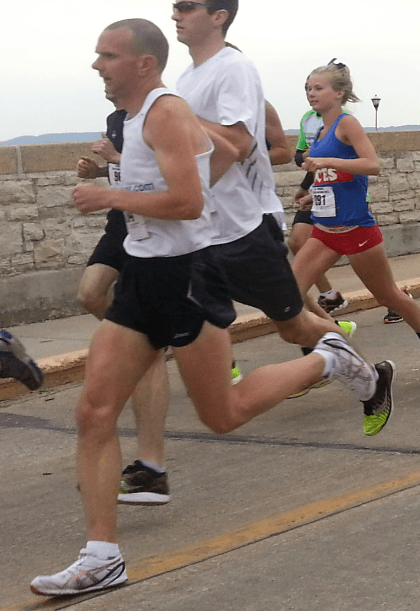

One more

This article was originally posted by Ryan at the original HillRunner.com Blogs.

If you’ve read my two most recent race reports, you might have noticed a pattern. About a week before the races, my training crashed. Fortunately, I bounced back in time for race day both times but I can’t keep counting on this happening.

So why did I crash both times, less than a month apart? The answer to that question appears to actually be more simple than one might think. I didn’t follow my own advice and I ran my workouts too hard. Essentially, I ran myself into the ground. I was fortunate that I recognized this both times and corrected in time but why did I fall into this trap not only once but twice in such a short time and what can we all learn about this?

The first time, it was simply a matter of getting too aggressive. I had one very challenging workout on my schedule. It felt so good to nail that workout, even though I had to dig deep to get it done, that I couldn’t resist the draw to feel that again so I ran later workouts harder than I should have. Meanwhile, easy days were not sufficiently easy to recover from such demanding workouts. I recognized this when I crashed but I then entered a shorter than usual training cycle between races and figured, with not as much time to train, I could put a little more into the workouts. Different reasoning, same trap.

I’m not sharing these examples of how I fell into the trap to make myself look like an idiot or to get your sympathy. I’m sharing these examples because they are examples of how easy it is to fall into the trap. I doubt I’m the only one here who has fallen into these traps.

So what should I have done and what will I do going forward? I’ll follow my own advice: finish every workout feeling like you could have done at least one more. If I do fall into the trap during a workout and run it too hard, I’ll take extra precautions in the following day or two to ensure I am adequately recovered before moving on.

Whether you’re running 30 second repeats or mile repeats, it’s good to aim to finish feeling like you could have done at least one more repeat. Even on long runs, finish like you could have run at least one more mile (I actually prefer feeling like I could have run at least 2-3 more miles on long runs). This will keep you from racing your hard days. Remember, save the racing for race day. On workout days, you’re generally not looking to challenge yourself. You’re looking to build yourself up. You need some stress to stimulate improvement but too much stress repeated too frequently will just break you down.

Race report: Walleye Run 5 mile

This article was originally posted by Ryan at the original HillRunner.com Blogs.

The story of this race again starts well before race day. I again pushed harder than I should have in training and, about a week before the race, crashed. I had a 13 mile run that was a significant struggle exactly a week before the race, then I completely crashed. It took me almost 45 minutes to run 5 miles 6 days before the race. Another slow 5 miles on Monday and I took Tuesday off. Other than relaxed strides Monday, Wednesday and Friday, I didn’t do anything hard this week until race day. I simply needed to get my legs back under me.

This is the race that has become a family event. By taking a pass on the shirts, for $20, I was able to register myself for the 5 mile, Lisa for the 2 mile and Shayla for the 1/3 mile kids fun run. What a family bargain. Also, they stagger the races sufficiently to allow me to finish my cooldown with enough time to let Lisa get ready for her run.

As a family event, we all piled into the car early this morning to head up to Fond du Lac. We arrived at the park a little later than I normally would. I headed off to pick up our packets while Lisa and Shayla stopped off at a picnic table to eat breakfast. The instructions in our packets clearly stated make sure your age and gender are correct on the bibs. Ours weren’t even filled in so I went off to find a pen and fill in Lisa’s and mine. Shayla’s was filled in but it didn’t matter because she was running a non-competitive event anyway.

I took a little time to relax, then it was time to get ready to warm up. No sign of Lisa and Shayla yet so I did what I had to do, then started walking out to run. I saw them coming so I let them know where I had our stuff and took off to run. The warmup started a few minutes later than I would have liked due to waiting for them but no big deal. I warmed up, with the legs feeling pretty grumpy at first but loosening up fairly well as I went on. I did my range of motion exercises, put my racing flats on, stripped down to my racing uniform and was off. A few strides at the start line, dropping my sunglasses with Lisa because they were fogging up and I was ready to go.

Lined up just to my right was bib number 1, last year’s winner. Oh, great. I’ll get blown away right off the line. Oh well, it is what it is.

As the race started, I did get blown away by bib number 1, as well as a few others around me. I must have picked a good position on the line to start because it seemed like all the fast guys were all around me. I quickly found myself in about 15th place but, like the last race, part of the reason for that was because my legs just didn’t want to go right off the line. It again took them about 1/4 mile to really start firing.

Image

Once my legs did get going, I quickly worked my way up through the chase pack, separated, then was staring down the lead pack of 7. In front of that pack was bib number 1, wearing a white singlet. I saw 3 blue Fond du Lac Running Club (FDLRC) jerseys and a few other guys. Pretty quickly, 3 guys fell off the lead pack and formed a chase pack. Now, the race was 4/3/me. I figured my only hope of moving up was picking off guys who fall off through attrition. I did try bringing in that pack but it just wasn’t happening so my new goal became to keep as close to that pack as possible so, if anyone fell off, I’d be there to pick them off. Before I knew it, the chase pack grew to 5 as the battle for first became a 2 man race. That didn’t change what I was doing, though. My focus was on the now larger pack and watching for weakness up there.

Through mile 2, there weren’t any signs of weakness. Generally, that pack was running shoulder to shoulder. One guy dropped behind but didn’t fall back. The rest were still running 4 wide. Just after the 2 mile mark, we went around the turn and the pack fell into a single file line. Still, though, no signs of weakness. Then, it started happening. At about 2.5 miles, one of the blue FDLRC jerseys lost a couple steps. Then 5 yards. I was like a shark smelling blood in the water. He still had a good lead on me but he was hurting. He couldn’t hold the pace. I pushed a little harder, knowing this was my chance. By the 3 mile mark, I had cut the gap fairly significantly and he was maybe 20 yards ahead. Just after the 3 mile mark, we had a 90 degree turn and I saw him look back. I thought "Yeah, that’s right, you’re mine" and found a surge of energy. About 1/4 mile later, I went by him and he had no response at all. I kept pouring it on. He wasn’t responding now but, if he could hang close, he’s a young guy who probably has a kick and I didn’t have a kick even when I was his age. I didn’t want him anywhere near me with a half mile to go.

Nearing the 4 mile mark, I saw another guy falling off the pack. He wasn’t fading quickly, though, and I didn’t have much time left. Was it enough time? I pushed but I didn’t have enough in me to really move. I kept pushing, thinking chasing him would help me build a gap on the FDLRC guy I had passed not all that long ago. With just less than a mile to go, we went around a turn. I thought about looking back, then thought about that turn a mile earlier. I didn’t want anyone behind me thinking I was his to pass. I kept pushing, assuming someone was there even though I was pretty sure nobody was. With 3/4 of a mile to go, another turn. I didn’t even think of looking back. I just kept pushing. I knew I wasn’t going to catch the guy ahead of me but I wasn’t going to let someone come up behind me. With 1/2 mile to go, another turn. I stole a quick glance but couldn’t see much. All I knew is there was nobody within the first 10 yards behind me. What if someone further back saw me? He’s thinking I’m not going to have a finish. I push as hard as I possibly can to make it clear I’m not fading, just in case. With 1/4 mile to go, I try to pick up the pace again. I’m not sure I did. Around the last big turn and I’m going with everything I have, which isn’t much. One more gentle curve and I see the clock just over 28 minutes. I try to sprint but my legs have nothing left. I go as hard as I can, which is basically the same pace I had been running, and cross in just over 28:20.

Image

Final result was 7th place overall, 1st in the 30-39 age group. 6th place was 42 seconds ahead of me. 8th place was 36 seconds behind me. I’m very happy with this result. Even before this past week’s struggles, I was thinking 5:40 pace or right around 28:20 would be a very strong run. With how the past week went, I was very worried that things could turn out far worse. My legs bounced back, though, and I ran about as perfectly on the original target as possible.

Official results

Lisa ran her 2 mile. She’s not exactly thrilled with her run but she says she now has something to improve upon. Shayla ran her run and was excited to finish ahead of mom (who ran with her) and at a faster pace than mom ran in her race. Then it was off to the festival for a few hours of run. A good day all around.

More on the 10% myth

This article was originally posted by Ryan at the original HillRunner.com Blogs.

After posting about the 10% myth earlier this week, I thought it would be good to discuss the primary argument I’ve received over the years against my view on this "rule".

To paraphrase, the argument goes something like this: Sure, you could increase by 15% or 20% for a week or two but that isn’t sustainable. 10% per week is the maximum sustainable rate at which one could increase their volume.

I usually respond with the question of how long one thinks you can sustain a 10% per week increase. I’ve yet to hear a response.

If you increase by 10% per week for 8 weeks, you’ve increased your volume by 114%. If you’ve been running 50 miles per week, you’re now at 107 miles per week in about 2 months. If you increase for 12 weeks, you’ve increased your volume by 213% and your 50 miles per week base has in 3 months turned into over 150 miles per week. By 15 weeks, you’ve topped 200 miles per week. Is this sustainable? Of course not. Depending on your circumstances, you’re doing very well if you are safely running 73 miles a week in a month’s time.

The argument I’m making is that we shouldn’t focus on numbers. Focus instead on how you’re feeling. At times, you might find yourself increasing by 15-20% or even more. At other times, you might find yourself increasing by less than 5% or even holding steady for a while. Forget about the numbers and focus on how your body is responding to your increases. Your body will lead you to far better results than some arbitrary formula.

Any other questions, concerns or comments about the 10% rule or why I feel the way I do about it? Don’t hesitate to ask.

The 10% myth

This article was originally posted by Ryan at the original HillRunner.com Blogs.

Everywhere you go, you hear about it. Even those of us who try to avoid hearing about it can’t get away from it. The "10% rule". That supposed rule that a person shouldn’t increase their weekly mileage by more than 10% from week to week or they will risk injury, fatigue, burnout, and a multitude of other bad repercussions. Of course, a corollary to this rule that some strongly promote is that, as long as you are within this guideline, you’re perfectly safe. Is this really true? Well, let’s look at a few facts as well as some observations I’ve made.

First, let’s look at the numbers. We’re told that this "10% rule" applies to everyone at all levels. OK, so how does a person start running? You can’t increase from zero miles by 10% and end up with anything but zero. Maybe that’s why so many people are afraid to start running. They would be breaking the "10% rule". OK, that’s a little extreme so let’s take a situation I was once introduced to. Someone ran 8 miles in a recent week and was asking what would be reasonable for the following week. This person mentioned that, by Wednesday, she was already on the verge of breaking the "10% rule" but still felt good, so did she really have to stick with 10% or could she go higher? I gave my usual advice, listen to your body and let it guide you. After all, is it really reasonable to expect a person to go from 8 miles to 8.8 to 9.6 to 10.5? If she was to do 9 or 10 miles that first week after the 8 mile week, would that mean sure injury or burnout? What if she tried to stick to 8.8 miles but measured a course wrong and ended up running 8.9 or 9 miles? She broke the 10% rule, now she’s going to get injured? Let’s be realistic here. There was no doubt in my mind that she was ready for 10, 12, maybe even more miles. Maybe she would have to maintain for a short time once she hit 12 miles but everything she said suggested that she was ready. Of course, that didn’t stop a "10% rule" proponent from saying I’m full of it and that she should in fact run 8.8 miles the following week, 9.6 the week after, and 10.5 on the third week. This person informed me that it was a proven and time tested principle. Really? I’d love to see the evidence of that but I’ll get to that later.

What about the opposite end of the spectrum? Some of those who promote this "rule" say that, as long as one stays within the guidelines, they will be fine. What does this mean for someone who just ran a 100 mile week? Well, that person runs 110 miles the following week, 121 the week after, 133 the next week, 146 on the fourth week, and 160 on week five. That’s a 60 mile per week increase in barely over a month. Staying well within these boundaries, a person could increase by 6 miles per day in a month’s period. What are the chances that someone could actually increase the training load this quickly without problems? Again, let’s be realistic here.

Next, let’s look at some facts. A number of sources will tell you that, as long as you increase by 10% or less, you are at a low risk of injury and burnout. As soon as you cross over to more than 10%, though, you are at a high risk of injury and burnout. This is a very interesting theory. All I can do is ask what makes 10% so special? I know of many people who, on a very regular basis, increase their mileage at a much higher rate with no repercussions. I have actually done that myself from the beginning of my running years. I also know of many people who have increased by much less than 10% and ended up with very serious injuries. From my observations, I have seen no sign that 10% is some magical turning point where injury risk suddenly increases. Also, I have seen no studies that have found this to be the case.

In the end, I just have to ask why 10%? Simple, it’s a nice round number that sounds good. It’s a middle ground. Many people get injured increasing at 5% or less per week, many others don’t get injured when increasing by 20% or more per week for a short period of time. Most runners will be safe at 10%, although many would also be safe at 15% and those who wouldn’t be safe may or may not be safe at 5%.

Well, if most runners are safe at 10%, why do I have a problem with this number? Simple, there is a better, less limiting and even safer way to increase. It’s called listening to your body. At points, if you listen to your body, you will probably increase your mileage by more than 10% per week. This is the point where 10% is too conservative and is actually limiting your training. At other points, if you listen to your body, you will probably increase your mileage by less than 10% per week and maybe even stop increasing for a few weeks before starting the buildup again. This is the point where 10% is too aggressive and runners who follow it to the letter end up developing problems.

Scroll to Top