
Nothing new on race day?

This article was originally posted by Ryan at the original HillRunner.com Blogs.

Image

Let’s be honest: it’s a little challenging to practice this, especially with crowds, anywhere but in a race

We’ve all likely heard the advice. Do nothing new on race day. Generally, that’s great advice and I’d encourage you to follow it. Practice whatever race day routines you can in training. Wear the shoes, socks, and gear that you plan to wear for race day in training. If you’re running a race that is long enough to warrant fueling, then practice your fueling strategy, ideally while running at least close to race pace, in training.

However, there are some things that we just can’t practice in training. It can be challenging to practice running in crowds. We can’t fully practice starting in an amped up atmosphere and holding ourselves back while the adrenaline is pumping. With some work, we can (and should) practice aid stations but, again, usually without crowds of other runners trying to get the same cups we’re going for and without volunteers handing cups to us in sometimes unpredictable ways.

This is why we should have tune up races. These are the races that are less important than the goal race but are still ones we should take seriously and, within the context of our training cycle, should be attempting to do our best at.

As much as possible, do nothing new on any race day. Ideally, do nothing at all new on the day of your goal race. In order to do that, plan some tune up races and do some new things that you just can’t practice in training at those races.
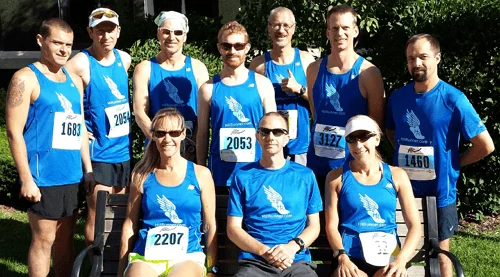
Team HillRunner.com: 2016 Al’s Run

This article was originally posted by Ryan at the original HillRunner.com Blogs.

Image

I feel like I’m running behind this year but it’s that time again! Al’s Run is just around the corner!

Al’s Run will be on September 17th this year. The start is on the Marquette campus in downtown Milwaukee at 10:30. After the race, I will invite all team members to my house as has become tradition to have a cookout and celebrate.

As has also become tradition, anyone who joins the team can get a HillRunner.com t-shirt or singlet. I may have a second color option available but, if you don’t already have the traditional blue (as seen above), I hope you will select that so it can be our team uniform on race day.

Just register here to join Team HillRunner.com and I’ll get more information to you as race day approaches.

A couple timely reminders

This article was originally posted by Ryan at the original HillRunner.com Blogs.

It’s hot out there. Here in Wisconsin, it’s been unseasonably hot for a while now and it’s not letting up yet. To the east, the heat has been settling in and, if what we’ve experienced in Wisconsin is any indication, I’m sorry to report that you might have a while to go.

So what do we do in the heat? Well, the usual things apply. Slow down, drink plenty of fluids, try to run during the early morning or late evening hours. What else should we keep in mind?

Well, for one thing, know what your medications might do to you. This is good advice any time. You should always be aware of the side effects any medication you’re taking, prescription or non-prescription, may have. As the heat bears down on us, remember that certain medications can cause heat sensitivity or exacerbate dehydration.

What’s another thing? Well, a piece of good news. I’m sure we’ve all heard about how dehydration affects our cognitive function. It turns out there may be more to that story than previously reported.

As usual, Alex Hutchinson does a great job explaining where the research is right now. Previous studies on dehydration and cognitive function were not all that well designed and performed. A new study, more well performed, suggested that cognitive function actually improved after dehydrating exercise but returned to normal during recovery and rehydration.

Does this mean that dehydration improves cognitive function? Absolutely not. In fact, some research shows that exercise improves cognitive function. If I were to hazard a guess, that’s where the post-exercise gains came from. However, more important, the results of this study call into question the results of the previous studies and at least suggest that, if there is decline, it may not be as significant as some have wanted us to believe.

Get off the roller coaster

This article was originally posted by Ryan at the original HillRunner.com Blogs.

Image

This kind of roller coaster is fun – the running roller coaster is not

It’s theme park month for me. I recently visited Six Flags and have a coming trip to Wisconsin Dells.

Those are fun roller coasters. The running roller coaster? Not so much fun.

What’s the running roller coaster?

The running roller coaster is the training routine I see so many people get stuck on and I’d like to encourage you to break. It’s the pattern where you train very hard for a few weeks, maybe even a month or two, then you get burned out or injured. You reduce your training significantly or stop running for a while to recover, then when you start back up you feel like you’re behind plan so you jump right back in to very heavy training and the cycle starts over.

So how do I avoid the running roller coaster?

I find myself repeatedly saying that I’d rather see you training at 90% of your capacity 100% of the time than training at 110% of your capacity 80% of the time. You’ll get much better results with that consistency than you will pushing harder but breaking down and missing time.

Some people like workouts where you go all out. They say it teaches toughness or it instills some ability to push harder on race day. I don’t believe in that. I believe they break you down. I would prefer you finish your workouts feeling like you had a little more left. Likewise, make sure other aspects of training are sustainable. Just because you can do a 50 mile week once or twice doesn’t mean you should. You will be better served sticking with 45 consistently.

I’m not suggesting you shouldn’t challenge yourself. However, do so judiciously. Make sure you’re not challenging yourself too frequently or too severely.

And save the all out efforts for race day.

Sweating the details? Take care of the big picture first

This article was originally posted by Ryan at the original HillRunner.com Blogs.

Image

Should I do a 15 mile long run or a 16 mile long run this weekend?

Should I do 4 strides or 5 before my workout/race?

Should I be doing my easy days at 8:20 pace or 8:30 pace?

Should I be doing my easy days at a heart rate of 150 BPM or 155 BPM?

Are these questions you find yourself thinking about? If so, stop for a moment.

Before asking those questions, you should be asking yourself the big questions. Are you getting in a long run on most weeks? Are you running on as many days as you can and need to meet your goals?

I see so many runners sweat these little details while missing the big picture. You may see incremental improvements by taking care of these little details. However, you’ll improve by leaps and bounds if you start asking yourself the big questions.

Scroll to Top