Training

All things training. Mostly advice and tips but maybe questions, general comments, or who knows what else.

Your Acute-to-Chronic (A:C) training ratio

This article was originally posted by Ryan at the original HillRunner.com Blogs.

Image

By now, I’m sure most of you know my thoughts on the “10% rule”. It’s far too simplistic. That said, there is such a thing as building up too quickly, right?

Of course there is. It’s just not as simple as this week should always be no more than 10% more distance than last week.

Ideally, we listen to our bodies to know if problems are creeping up but what if we had cues to tell us when we may need to pay closer attention or take concerns more seriously?

Enter the Acute-to-Chronic training ratio (what I will abbreviate as the A:C ratio).

What is the A:C ratio?

It’s simply your past week’s running mileage divided by the average of your past 4 weeks. An example might be helpful.

Let’s say your past 4 weeks have looked like the following:

45 miles

50 miles

55 miles

60 miles

Your A:C ratio is then 60 / 52.5 (52.5 is the average of 45, 50, 55, 60). Rounded off, this is 1.14.

Research has found that, on average, injury risk climbs when you hit a ratio of 1.2 and significantly increases around 1.5.

However, that’s for the “average” person. How many of us are perfectly average? If you look at your history, you’ll probably find that there is some fuzzy area where you cross from being relatively solid with no real injury concerns to where you feel like you’re walking a tightrope.

With this knowledge, you could actually adjust to where you know that, for example, at 1.3 you begin feeling not so great and bad things happen when you get over 1.6. So you can watch for those numbers instead of 1.2 and 1.5.

Also, some suggestions are that you take intensity into account. Not all miles are equal. A 5 mile tempo run is more strenuous than 5 miles very easy. This is a little more complicated to keep track of but might make this kind of ratio even more useful as you can track increases in both volume and intensity.

Why is this better than the 10%rule?

To be honest, this is a similar concept to the 10% rule but, depending on how deep you go, it offers more flexibility.

First, in even its most simple sense, you are given two levels to watch: graduated risk and high risk. It’s not as simple as 9.5% = good, 10.5% = bad.

Second, I like the idea that it doesn’t just take a look at the past two weeks. By looking at the past 4 weeks, it gets a more complete picture of your recent training, not just a very limited snapshot. It would be great to look at 2-3 months, of course, but I get how that would complicate things. 4 weeks seems like a decent compromise.

Third, the idea and, in some circles, encouragement to adjust those numbers to your unique needs is outstanding. Track your history, find the numbers that work for you, then adjust.

Finally, if you go the most complex route and add in intensity, you’re measuring not just volume but total training stress. This is an outstanding, though admittedly much more complex, addition to the equation.

In the end, obviously, we aren’t robots. No numerical formula is going to perfectly predict injury risk. You might get injured when your A:C ratio is below 1 (meaning you’re reducing training load) or you might be able to stay healthy when it’s above 2. At 1.3, you might get injured one time but not another. However, if we can track when our risk is increasing, we can be more aware of that and take more precautions.

Addition to the training log

So what does all of this do for us if we’re not easily able to track it? That’s what I started asking myself and I realized I had the ability to offer a solution.

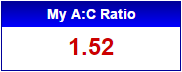
Starting this morning on the HillRunner.com Training Log, you can track your A:C training ratio. It’s right there on your sidebar, easy to see and updated in real time as you update your training log.

Currently, it’s the most simplistic solution. If your ratio is below 1.2, it will show up as green:

Image

From 1.2 to 1.5, it will be orange:

Image

1.5 and above, red:

Image

In the future, I plan to build out this functionality as follows:

First, I want this to be an optional sidebar widget, as are some of the others such as the weather widget, controllable through your log settings.

Second, I plan to make those thresholds customizable. They will default to 1.2 and 1.5 but you will be able to change them to the numbers that work best for you.

Finally, my most ambitious thought is to include intensity. This will take more work as the log doesn’t currently track intensity but I’d like to see it included in the long term future.

As far as I know, the HillRunner.com Training Log is the first log to include this A:C training ratio. As always, I am aiming to provide an easy to use, convenient, but useful training log. I hope this is an addition that, while not affecting ease of use, will conveniently add a useful tracking measure.

Photo credit: PSY_1987 by Inland Empire Running Club, on Flickr

Restraint

This article was originally posted by Ryan at the original HillRunner.com Blogs.

Image

Spring is on the way! While many of us already had some summer like weather this year, we’ve also faced some challenging winter weather. Things will be taking a turn soon if they haven’t already begun taking a turn where you are.

It’s so easy when the weather gets better in the spring to get a little too excited about training in good weather and try to do too much. Be careful not to fall into this trap.

After working your way through all the bad winter weather, the last thing you want to do is get yourself hurt when the weather is turning nice, especially since your racing season is likely also just around the corner.

Photo credit: DSCI0012 by Tory Klementsen, on Flickr

“Bad” workouts happen

This article was originally posted by Ryan at the original HillRunner.com Blogs.

This week, we had serious wind on Tuesday, my workout day. It was brutal, I was being blown all over the place and my splits during the first half of the workout, when running into the wind, were horrible.

Earlier this year, I had a workout where I could just feel things weren’t going well. It wasn’t the conditions that time. My body just wasn’t responding. It wouldn’t go no matter how much I wanted it to.

Whether due to the conditions or due to it just not being our day, we all have workouts that just don’t go so well. Bad workouts happen. What should you do about it?

Don’t get down

First, don’t get down on yourself if you’re having a bad workout. If you’re having a bad day, just chalk it up to that. We all have bad days. I expect, in any given training cycle, that we will all have a few workouts that just don’t go our way. It’s built into the expectations. When you have that day, just accept it and move on. Analyze why it happened and, if changes can be made to reduce your risk of a repeat occurrence, make those changes.

Most important, don’t dwell on it. What’s done is done. Learn from it if there was a lesson to be learned and move on.

Adjust if needed

During the workout, ask yourself if you’re still accomplishing the goal of the workout. Sometimes, even if you’re not hitting the splits you were aiming for, you’re still accomplishing the goal. In the case of my workout this week, my splits look pretty ridiculous but I know I accomplished what I wanted. In the case of my earlier workout, I wasn’t running the paces I wanted but I was still getting the training stimulus I was aiming for. So, in both cases, I didn’t worry about the watch and just ran.

If something doesn’t feel right, especially if you feel like an injury might be on the way, stop the workout immediately. If the conditions you’re facing are dangerous, stop the workout and find shelter immediately. If you’re just feeling so off that you can’t hit the kind of intensity you’re looking for in the workout, cut it short and move on.

Build mental toughness

This is mostly for workouts in bad conditions but also applies to workouts when you’re just not quite feeling right. Toughing it out in these workouts will make you a mentally stronger runner. If you face similar conditions on race day, chances are they aren’t going to cancel or postpone the race. You’re going to be running in them. If the conditions are good on race day, think how easy it will seem after running through more challenging conditions.

Likewise, if you’re feeling a little off on race day, they aren’t going to postpone it until you’re feeling better. You better be prepared to do your best regardless of how you’re feeling.

In the end, I would consider both of the challenging workouts I had this year productive. Not only did I still get them in and accomplish the stimulus I was looking for. I also toughened myself up. I’m not down on myself for running slow in the first half of my workout on Tuesday, just as I’m not getting carried away by the pace I had with a tailwind in the second half. I am very happy, though, that I battled through and got the workout I wanted even if the conditions weren’t ideal.

Be your own best advocate

This article was originally posted by Ryan at the original HillRunner.com Blogs.

This past weekend, someone sent me this article. It’s an important reminder and I’d like to make a few points that I see often referenced but just as often ignored:

– If something doesn’t seem right, something is likely not right. We all have to struggle through fatigue and aches at times but most of us have a sense of what is “normal” and what just doesn’t feel right. Trust your gut. In this individual’s case, he knew something wasn’t right when his paces dropped off rapidly. That’s a telltale sign that something is wrong. At the very least, you’re not going to get more out of your workout when you’re fading like that for no clear reason so don’t push your luck.

– If you feel unexplainable chest, back, or shoulder pain, take it seriously. See a doctor.

– Even more, make sure you are your best advocate. It sounds like this individual had a good medical team looking out for him. Too often, a runner with normally stellar numbers comes in with “normal” numbers and is told you’re fine. If your numbers look out of line to your normal, point this out. Be annoying if you have to. It could save your life.

Racing: a skill that requires practice

This article was originally posted by Ryan at the original HillRunner.com Blogs.

This time of the year, we likely have our goal races in sight. We may already even be registered for them. However, do you have some other races on your schedule? This is a good time of the year to pick some secondary races to fill out your schedule and make sure you’re race sharp when your goal races come around.

Many runners seem to not worry about this part of goal race preparation. They figure they will train themselves into the best shape possible and take advantage of that fitness. So why do these other races matter?

Because racing is a skill and, like all skills, you need to practice it in order to be good at it.

Whether you’re running a mile or a marathon, whether you’re going for the win or in the middle of the pack, there are aspects of the race that need to be practiced. Here are a few ways you can benefit from practice races (I like to call them tune up races).

Pre-race routine

How early do you need to get up before a race to be awake and ready to race? How much do you need to eat or drink and how long before the start do you need to eat? Do you need a warmup? If so, what is the routine that works best for you?

These are all questions that we can try to answer in training and I would recommend doing so. However, the best solution can’t be found in any way other than race day practice. Due to nerves, some people have stomachs that are more sensitive on race day. You need to be more awake, alert, and ready to go even for a marathon than you do for a weekly long run or an easy run.

Race strategy

If you’re in the middle of the pack, competitive strategies may not matter to you. If you’re going for a win, top 10 finish, or age group placement, competitive strategies matter much more. However, even if you’re in the middle of the pack and focusing on a time goal, there are race day strategies that matter.

For the competitive runner: You need to have some race day strategies and practice them. What happens if your competition plans to sit and kick on you? Do you grind out a pace you hope will run the kick out of them? Do you surge and try to break them? Do you begin your kick early and try to get the jump on them? If you do some tune up races, you can practice these different strategies and be prepared on the course to decide which gives you the best chance. Then you can be ready to execute with confidence.

Likewise, you can develop, practice, and test your ability with other strategies. Maybe you’re a good kicker and you want to be the person sitting and kicking. You can work on maintaining contact while your competitor tries to grind you out or work on how to cover surges

Just as important, these tune up races give you the opportunity to assess your weaknesses and work on them so they can’t be exploited by your competitors. Do you tend to fade in the second mile of a 5K or third quarter of a mile? Then run some races where your aim is to push hard through those spots. Tell yourself it doesn’t matter how you finish, what matters is that you push through the area where you usually let up.

For the middle of the pack runner: You might think it’s simple. Just lock into a pace and carry it through. However, how do you handle the crowds, especially if you’re doing a big race? If you’re doing a long race, how do you handle fueling? If you’re going to use the aid stations, how are you going to go into them? As with the competitive runners, do you need to practice pushing through a part of the race where you often lose focus and let your pace lag? This could be the key to a PR.

Just as with the competitive runner, you can plan these things but there are logistical issues that you likely won’t anticipate until you’ve encountered them in a race. Even more, some of these issues are skills that need to be practiced. You can practice drinking out of a paper cup while on the run in training but race day is different. You’re not in crowds, you don’t have a complete stranger handing the cup to you, you’re not potentially running across discarded and potentially wet and slippery cups while trying to drink from your own cup.

Pushing yourself

I know others look at races differently but, when I’m racing, I’m looking to test my limits. I want to push myself to the very edge of my ability.

Almost every year, when I run my first race of the year, this just doesn’t happen. I don’t push myself that way in training so I haven’t pushed myself that hard in months. I’m simply rusty. I need to remember what it’s like to take myself to the limit.

If you’re not pushing yourself to the limit in workouts (and I hope you’re not) you’re going to need one or two race efforts to get the feel for doing that. If you don’t, you’re going to be out of practice and not going to be ready to push yourself like that on race day.

It doesn’t matter if you’re going for the win or running in the middle of the pack. It doesn’t matter if you’re racing the competitors around you or shooting for a time. It doesn’t matter if you’re running a large or small race. It doesn’t matter if you’re running a mile or a marathon. It doesn’t even matter if the tune up races are the same distance as your goal race. Getting some tune up races will help you when your goal race comes around. There are simply some skills that can’t be practiced any way other than by running in a race. So, now that you likely have picked out your goal races, go out and find a few tune up races to prepare for them.

Scroll to Top