Training

All things training. Mostly advice and tips but maybe questions, general comments, or who knows what else.

Speed = stride length * stride rate. Period.

This article was originally posted by Ryan at the original HillRunner.com Blogs.

Image

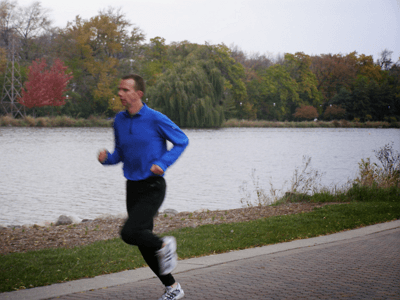
This guy has both parts of the equation covered

Some time ago, I heard a very good coach who I greatly respect say there are three factors that go into speed. Stride length, stride rate, and ground contact time. I’ve heard a lot of similar comments from other runners and coaches.

I’m sorry and it pains me to say this about some people who I greatly respect but they are wrong. It’s even more simple. Speed, if we’re going to look at the pure mechanics of it, is simply based on two factors: stride length and stride rate.

In physics, we learn that speed is distance covered divided by the time it takes to cover that distance. A very straightforward equation, the kind I like.

In physics: Speed = distance / time

To apply that formula to running speed, we get a likewise simple equation: Speed is stride length (distance covered) times stride rate (1 / the time it takes to cover the distance).

In running: Speed = stride length * stride rate

What about the other factors?

What about those other things, such as ground contact time? Those things definitely matter but they are components of the two key aspects of speed. A lower ground contact time or less time spent in the air will lead to a faster stride rate as long as one doesn’t negatively affect the other. Covering more distance while in the air increases your stride length as long as it doesn’t mean you’re covering less distance while on the ground.

Why does this matter?

It matters because it helps us wrap our minds around things if we start at the highest level. If I want to run faster, I need to either take longer steps or take them more quickly. In addition, taking steps more quickly doesn’t necessarily help me run faster if they become shorter and longer steps don’t necessarily help if they are taken more slowly.

If we add other factors that are components of these two factors, we can overemphasize one factor to the detriment of the other. For example, if we say the three factors are stride rate, stride length, and ground contact time, we might focus more on improving our stride rate to the detriment of improving or maintaining our stride length.

Which is more important?

BOTH! Seriously, both are equally important.

Possibly without even realizing, we often see people focus on one to the detriment of the other. We’ve probably all seen the long striders, really working to extend the distance they cover with one step essentially by bounding. The problem is they slow their stride rates often by an amount that causes them to slow overall, even with the longer stride length.

Likewise, I once had a long discussion with a runner who wanted to improve his 800 meter time. Somewhere, he had heard that world record holder David Rudisha ran with a stride rate of 220 steps per minute so he thought that was optimal and tried to match that. He couldn’t understand why his repeats slowed when he ran at 220 steps per minute. The reason was because he was trying to take his steps so quickly that he was shuffling. If Rudisha was really running at 220 steps per minute, which I’m not fully certain of, he had the power to deliver an incredible force to the ground in an astoundingly rapid rate so he could take long steps while doing that. If we consider his world record of just under 1:41 and simplify our assumptions to make the math easy, we would come to the conclusion that he took roughly 370 steps to cover 800 meters. With some rounding error, that’s roughly 7 feet per step.

So what do I do with this information?

Good question. Over my next two Thursday posts, I’m going to cover what we can do to improve each part of the equation. Next week, I’ll focus on stride length. The following week, I’ll focus on stride rate.

In the end, though, we also have to remember that, for the distance runner, the most important factors are fitness and efficiency. If you expend too much energy on either or both of these factors, you can’t make it to the finish line. It’s still good to know about these factors so we can try to improve them efficiently. However, in the end, your fitness and efficiency are the biggest factors in how fast you will run at your next race.

Note: This is part 1 of a 3 part series:

Part 1: Speed = stride length * stride rate. Period.

Part 2: Improving stride length

Part 3: Improving stride rate

Photo credit: David Rudisha by SNappa2006, on Flickr

Deal with the little issues before they become big

This article was originally posted by Ryan at the original HillRunner.com Blogs.

Image

Have you ever found something not feeling quite right and ignored it? What was the result? Chances are you ended up injured not too long after.

Pay close attention to these things. It’s true that we can’t always cut back our training every time something is a little off or, especially as we age, we’d never be training at full capacity. However, we can and should at least pay attention to these things. We can be proactive immediately and, if they get progressively worse or don’t go away for an extended period of time, we can adjust our training before we’re forced to take time off.

Being proactive doesn’t have to mean rest. It can mean "prehab" as some people call it. A little extra stretching, some strength work to target weaknesses that may be the root cause of the problem, maybe a massage appointment. Whatever it takes, it’s better to do a little up front than to be forced into a long time off down the line.

If being proactive isn’t enough, then it’s time to make some hard decisions. Will reducing training load for a week or two help? Will taking a day or two off, even a week, now prevent a longer forced time off later? If so, isn’t doing that worth it?

I will definitely expand on this in the future. As for now, just a quick reminder to pay attention to the little things and deal with them before they become big problems.

Photo credit: Running painful ankle injury by 4Chion Marketing, on Flickr

Fitness first, details later

This article was originally posted by Ryan at the original HillRunner.com Blogs.

Image

I’ve recently been writing a lot of Seattle Marathon training plans and a common theme has been coming up, especially for beginning runners or those who have been out of running for a while. The most important first step isn’t some magic bullet, it’s building basic fitness.

A lot of these plans I’ve been writing haven’t been all that exciting. Some involve workouts only once every two weeks, if at all. Most involve fairly conservative volume progressions. The most elaborate aspect of these plans often is the fact that I’m asking the runner to consistently get a run in 3-4 times a week.

It might seem that the people paying for these plans aren’t getting what they are paying for. However, as I explain in the emails I’m sending them, they are getting just what they need.

When you’re new to running or you’re getting started after a layoff, you need a good foundation to start. There are no shortcuts. There is no magic bullet. There is simply basic work that needs to be done.

Once you build that foundation, you can do more extravagant things. Until that foundation is in place, though, those things are a greater risk than benefit.

So, if you’re new to running or newly returning, make sure you start with the basics. It may not be exciting but it’s the safest and best way to get to where you want to be.

Relax and let the speed come out

This article was originally posted by Ryan at the original HillRunner.com Blogs.

Image

He knows what he’s talking about

If you watched the US Olympic Trials coverage on NBC, you may have noticed Ato Boldon repeatedly say that the fastest sprinters would "relax and let the speed come out". I was hoping he would use that line again in the Olympics but I didn’t notice it the way I did at the Olympic Trials.

Why was I hoping for the repeat? Because that advice Boldon was offering to any sprinters who were watching is also great advice for distance runners.

What does advice on sprint mechanics have to do with distance running? A lot.

Boldon’s advice is universal. When you tense up, your opposing muscles are working against each other, requiring more energy to do the same amount of work.

A simple way to think about this is to think of the opposing muscles of the upper arm, the biceps and triceps. If you’re trying to bend your elbow to lift something, you need to flex your biceps muscle. However, what you don’t always think about is that you also relax your triceps muscle. If you don’t, your triceps muscle is pulling to straighten your elbow and working against your biceps.

What does this have to do with relaxing to let the speed come out?

When you’re tense, your muscles are contracting. When you’re relaxed, as the term suggests, your muscles are relaxed. Only the working muscles are contracting.

When you’re tense, your contracting muscles are fighting against each other. When you’re relaxed, only your working muscles are contracting to do the job. There are no opposing muscles contracting to work against your working muscles.

In short, when you relax, you’re not spending energy to work against yourself. You can save energy and deliver more power into the work you want to get done (like propelling your body forward).

So what do we do now that we recognize how important it is to relax in order to let the speed come out? Practice, practice, practice. I see a lot of runners, myself included although I’ve been working on it in recent years, who strain and get very tense when working hard. Whether in workouts or races, you can see the strain in their faces and, many times, throughout their bodies.

In training, try to focus on fighting the urge to tense up and strain. Work on staying loose when the going gets tough.

Photo credit: Ato Boldon by Dhanika Ranasinghe, on Flickr

Nothing new on race day?

This article was originally posted by Ryan at the original HillRunner.com Blogs.

Image

Let’s be honest: it’s a little challenging to practice this, especially with crowds, anywhere but in a race

We’ve all likely heard the advice. Do nothing new on race day. Generally, that’s great advice and I’d encourage you to follow it. Practice whatever race day routines you can in training. Wear the shoes, socks, and gear that you plan to wear for race day in training. If you’re running a race that is long enough to warrant fueling, then practice your fueling strategy, ideally while running at least close to race pace, in training.

However, there are some things that we just can’t practice in training. It can be challenging to practice running in crowds. We can’t fully practice starting in an amped up atmosphere and holding ourselves back while the adrenaline is pumping. With some work, we can (and should) practice aid stations but, again, usually without crowds of other runners trying to get the same cups we’re going for and without volunteers handing cups to us in sometimes unpredictable ways.

This is why we should have tune up races. These are the races that are less important than the goal race but are still ones we should take seriously and, within the context of our training cycle, should be attempting to do our best at.

As much as possible, do nothing new on any race day. Ideally, do nothing at all new on the day of your goal race. In order to do that, plan some tune up races and do some new things that you just can’t practice in training at those races.

Scroll to Top