Ryan

Leucine for recovery and endurance vs. speed

This article was originally posted by Ryan at the original HillRunner.com Blogs.

I’m writing this before heading out for a camping trip. I’ll be packing up my tent for the return trip home when this appears so sorry if I seem a little short this week.

Leucine

We all know by now that taking in a protein/carbohydrate combination as soon as possible after a run will improve our recovery, right?

Well, now we know that leucine also plays a role.

First, what is leucine? In short, it’s an essential amino acid that the human body can’t produce so we have to get it from our diet. For more, see this Wikipedia article on it.

The good news? The super recovery drink known as chocolate milk has some leucine in it. Not quite at the levels used in the study but it’s there at some levels. Other options would be soybeans (chocolate soy milk?) and peanuts (some people like peanut butter as part of a post-run recovery meal). Again, you can see the Wikipedia article for more sources.

Endurance vs. speed

The eternal debate: how much endurance training do we need and how much speed training? It’s all about finding the right balance. Unfortunately, in today’s world, too many people want debates to be far more polarized. So we end up hearing that the best way to improve your aerobic capacity is HIIT training and you don’t need to train with long, easy or moderate workouts if you just do your HIIT training.

Steve Magness, one of my favorite bloggers, explored this in the context of the recent World Cup. Not surprisingly, he came to the conclusion that it’s all about finding the right balance.

Summer training, fall results

This article was originally posted by Ryan at the original HillRunner.com Blogs.

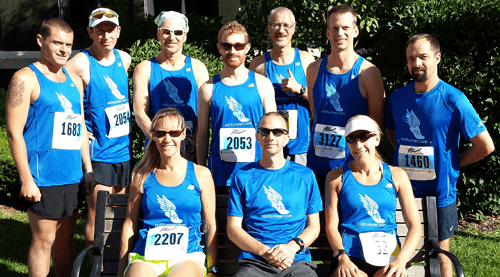
ImageTeam HillRunner.com before an early fall race in 2013

What are you doing now to win this fall?

What you’re doing now will determine how your racing season goes this fall. Whether a "win" for you means winning a race, placing in your age group or reaching a time goal, the work you get in during the summer will go a long way toward determining whether you get that "win".

We all know distance running isn’t an instant gratification sport. You have to put in months of work to get good results. Well, check the calendar. Your fall race may be as little as two months out and surely isn’t more than five months out. You may have already hit the heart of your training schedule if you’re two months out. Even if you’re five months out, what you’re doing now will affect how hard you can work a few months from now when you are in the heart of your schedule.

So get out there. Make today count. Your fall racing season depends on it.

Fascia, drafting as a placebo, dangers of tapering

This article was originally posted by Ryan at the original HillRunner.com Blogs.

Another interesting batch of links this week in my opinion. Let’s jump right in.

Fascia

Most of us probably don’t think about our fascia short of that one well known part of it that runs along the bottom of our feet. However, it is extremely abundant throughout our bodies and important in so many ways.

Running Times had a good primer on it that I came across this week. I’d consider this a must read. I’m partly including it here so I can reference it myself and read it again.

Is drafting a placebo?

That’s the question Alex Hutchinson asked in one of his Sweat Science blog posts from this past week.

As usual, I think Hutchinson has a great point when he says there is a difference between placebo and avoiding mental fatigue. Just because something may not be measurable doesn’t mean it isn’t real. We may not notice a difference in wind resistance but that doesn’t mean there aren’t benefits, as he points out, in terms of mental fatigue in drafting. I found myself thinking the same thing he wrote as I was reading the paragraph before he wrote it.

Of course, then I also found myself thinking the same thing he was about to write moments later. Sometimes, with some personality types, a runner may experience less mental fatigue by leading than by following. It all depends on the type of runner you are. Once again, know yourself and you’ll be able to decide the better strategy but we can’t overlook the benefit of pacers who make our jobs easier. Expending less mental energy worrying about pace early can mean having more mental energy later to push through the physical fatigue or to strategize.

Dangers of tapering

Most of us know the taper is quite possibly the most difficult part of a training plan there is. I probably spend more time thinking about the taper than I do anything else. What to do to get things just right? How to make sure you find that balance of enough rest without going stale from resting too much?

Well, Steve Magness has some thoughts on this. I always like Magness’s writings because he does such a good job of balancing the science of sports physiology with the art of coaching. This post is no exception.

So what’s his answer to what’s the right taper? As with most things, the answer is it depends.

Find what type of athlete you are and remember what event you are training for. Do you need the psychology of the routine? Do you need more speed/power? Are you more FT or ST orientated? What event are you tapering for?

These questions and more will hopefully help you solve the conundrum of tapering.

Good thoughts as always. Definitely worth a read.

It’s Not Quality vs. Quantity

This article was originally posted by Ryan at the original HillRunner.com Blogs.

Note: This is an article I first wrote at least a decade ago for the articles section of HillRunner.com. As I’m in the process of retiring that section, I’m moving all articles to the blog in their original form. This is the final one. I would likely write this somewhat differently if I were to rewrite it today but I want to keep it in its original form.

Over and over again, I see the debate come up. What is more important? Quality or quantity? Is it that simple, though? Can we really narrow this question down to one or the other? In recent years, it seems like many people would have you believe it is that simple. They refer to quotes such as "if you want to run fast, you have to run fast" and say that race performances are dependant on quality and quantity is not important. They frequently talk about "junk miles" as if anything that isn’t a hard day is useless. Interestingly, it seems as if the "mileage junkies", as some of these people like to term high volume runners, don’t take the same kind of angle. I can’t think of one high volume competitive runner who has done high volume training to the exclusion of quality workouts or one high volume proponent who has stated that quality done at the right time is not an important aspect of training for competition. I can, however, think of many high intensity runners who have done high intensity to the exclusion of aerobic conditioning and also many people who say high volume training is unimportant, some who even say it is detrimental.

If you are interested in maximizing your performance potential, you have to consider all the variables that go into your performance. Just like a race car mechanic. It doesn’t matter how good the tires of the car are if the engine has no power. It doesn’t matter how powerful the engine is if the drive train can’t handle that power. It doesn’t matter how strong the drive train is if the tires can’t hold up at high speeds. For a runner, it doesn’t matter what speed you have if you don’t have the aerobic capacity to run at a high effort level for the duration of the race. It doesn’t matter what your aerobic capacity is if your muscles do not have the strength and stamina to go the distance. It doesn’t matter what strength and stamina you have if you don’t have the speed to turn it into a fast race pace. With any piece of the running puzzle missing, you are not a complete racer and you will not perform up to your highest potential.

So how do you get all the components needed? By mixing the right amounts of both quality and quantity at the right times. This comes back to periodization, which I’ve already discussed in another article, but in terms of this article it means finding the right balance of quality and quantity. In this way, quality and quantity are not opposing forces. As a matter of fact, if you don’t view them as opposing forces, you can bring them together to work as a pair of complimentary forces pushing you to whole new levels of running performance.

The obvious question that comes up next is how to find the right balance of these two powerful forces. Well, if you have been reading popular magazines and websites over the past decade, the first step is to forget everything you have read. Go back to the drawing board and re-learn the basics of training for competitive distance running. The first rule of distance running is that you have to be able to cover a distance or even farther comfortably before you can race the distance. This means base training. Run a lot of miles and become real comfortable with running the distance and longer. This is the basis for everything that comes later and this is where quantity is the focus. After at least a few months of this, you should be comfortable covering your race distance, farther if your goal race is on the shorter end of the spectrum (half marathon or shorter) and maybe a little shorter for the real long races (marathon or longer), and your base should be pretty well established. At this point, you can maintain your base while establishing the speed needed to race the distance. This is where quality becomes the driving factor in your training plan. You are prepared to cover the distance, you can now maintain that by maintaining at least some of your quantity and now focus on building the quality to push yourself to speeds that you had never been capable of reaching before. The final result is being able to run a fast pace thanks to the quality and being able to maintain that fast pace all the way through your race without hitting the wall thanks to the quantity. Obviously, this is simplifying a well thought out training plan quite a bit but it points out how both quantity and quality are needed in order to reach optimal performance.

A lot of people will tell you that doing high volume will detract from your speed workouts, which will hurt your race performances. Don’t buy into this. It may be the case if you’re doing more than your body can handle, likely in terms of running too fast but possibly in terms of running too far, on your recovery days. However, I can tell you from experience and I could find many others who could share similar experiences that my best workouts came during my highest volume periods of training. During 2002, my highest volume period of training ever at that time, I was doing workouts that were blowing my mind. I was running repeats at 10-20 seconds per mile faster than I had ever previously been capable of doing on lower volume training. Why? Because, instead of beating my head against the wall with more and more intensity, I took a step back, found my balance, and gained an incredible amount of fitness by building my base to a level I had never been at before. My high quantity helped fuel the very high quality training I did when the time was right and the combination of the two led to my reaching the highest level of fitness I had ever experienced. If I had excluded either the very high quantity or the very high quality I had been doing, I never would have reached the level of fitness I did through a balance of both powerful forces.

In the end, if you are looking to perform at your best, it’s not about one or the other. You can’t ignore or even short one aspect of training if you want to be the best you can be. You need to hone the powers of all aspects of training and bring them together for ultimate fitness. That means you have to go through periods of high volume training, whatever that means for yourself as an individual, as well as periods of lower volume but higher intensity training. If you leave any of the aspects out or even if you shortchange any of these aspects, you will not perform up to your capabilities.

July 4 Race Report

This article was originally posted by trivianut at the original HillRunner.com Blogs.

Ok, so I don’t race as much as I used to. But at age 50, with injuries and very inconsistent training the last 6 years,I’m glad for the last 6 months of pain free running where I’ve run 3 out of every 4 days during this time. Most of these runs have been on the dreaded treadmill, which has been much more forgiving on my knees. I had planned to run the Milton Independence Run on 7/4, but had no idea what to expect. All my treadmill runs were btw 7:45 and 8:15 pace, and my longest run was just 7 miles. My feeling was I could probably hold 7:00 pace, but would likely fall off in the last few miles due to my lack of overall mileage. I was right about that.

We had great weather in Wisconsin for the 4th, with temps in the low 60s at 8:00am. I could tell at the start that running easy for the first mile would still be too fast. 6:20 was too fast, but it was time to start working. After the 2nd mile in 6:36, I thought I was in a better pace. The mostly uphill 3rd mile was 7:00, and the return 4th mile only 4 seconds faster in 6:56. So my sub 7 cushion was gone, and I just had to hold on to the finish. It didn’t help that from 1.5 to 5.5 miles there was no one within 50 yards of me ahead or behind to key on. When I finally started getting caught by other runners, I did two things; sized them up for age group competition, and tried like heck to stay with them. I was passed by 5 runners in the final mile, but managed to stay within 5-10 seconds of all of them as the final mile was 7:18. My finishing time of 43:03 shouldn’t disappoint me, as my last race 11 months before was a 5k at the exact same pace (21:31).

So what to take away? More mileage, and probably start to do some faster tempo pace, as I’ve done nothing but steady state runs for the past 6 months. Only race on my current radar is Al’s Run, and I want to do well for Team Hillrunner. Oh and btw, I got 2nd in my age group, 25th overall out of 250 or so runners. My 23 year old son ran his 2nd ever 10k, and had a 10 min PR, running 46:52 to win the 20-24 age group. He says it must be in the DNA. Sniff, I think I need a tissue…

Scroll to Top