Ryan

Staying upright in winter weather: traction devices

This article was originally posted by Ryan at the original HillRunner.com Blogs.

Image

After my winter running post last week, I saw a few interesting topics/questions come up on winter running so I’d like to delve a little deeper into a few topics. First, tools to help keep traction while running through the winter.

First things first, there are times when nothing will give you great traction. At these times, you may need to adjust your running. Take short, quick steps, keeping your feet closer to directly under your center of gravity. Slow down – a lot – and even stop to walk if necessary. Especially when changing direction. I will possibly write more about this later. That said, what we put on our feet can improve our chances of keeping our feet under us in bad conditions.

The second thing to note is that different methods work in different conditions. Snow and ice can both present problems and what works best for one may help for the other but what is best for one may not be best for the other. On that note, here are my suggestions for both snow and ice.

Snow

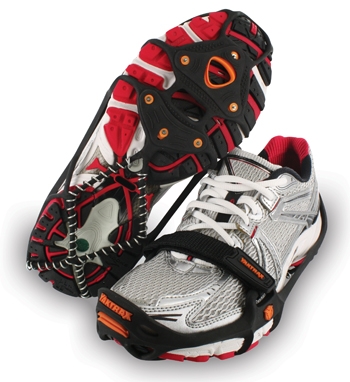
The main problem when running in snow is that most road running shoes don’t have enough tread to get down into the snow and get some grip. The best solution I’ve found for this is to get a pair of trail shoes that have an aggressive tread pattern. For those of you who like minimal shoes, look into cross country flats. These shoes are basically like snow tires for your car. The treads will get down into the snow and give you a better grip. Devices like Yaktrax (I’ll discuss them more later when discussing ice) might help because the coils and spikes will play the role of the tread that gets deeper into the snow but, in my experience, the tread of trail shoes or cross country flats works as well as anything.

If you’re running in good packing snow, you might find the snow clumping up in your treads and reducing your traction. Trail shoes and cross country flats are usually pretty good at shedding snow but there is some snow that is just too stubborn and you need some help. An old trick from high school and collegiate cross country teams is to spray the bottom of your shoes with non-stick cooking spray. Just as the spray will help keep your food from sticking to your pans when baking, it will help keep the snow from sticking to your shoes while running.

Ice

The main problem when running on ice is different. No amount of rubber is going to penetrate the smooth, hard surface. If the ice is pitted, the tread on trail shoes or cross country flats may help but it won’t be a cure all. If the ice is smooth, the trail shoes or cross country flats may be useless. So we need to look elsewhere. In short, we need to add sharp metal edges that will chip into the ice, giving us some traction.

There are several methods for doing this. I already mentioned Yaktrax, also pictured at the top. I question the value of the coils on smooth ice but the spikes in the picture above would work well. There are other similar products but Yaktrax are the most popular for runners and, with the strap that goes over the top of the foot, seems like the most sure to stay in place while running.

If you’re a minimalist runner, you might consider cross country spikes. With these, you get a nice combination of the tread to help with snow and, to some extent, on pitted ice plus metal spikes to help with ice. I’ve been using these with a lot of success over the past two winters and my only complaint is that I didn’t think of this sooner.

If you’re concerned about prices, there is another option that I used for years before trying cross country spikes. This would be the screw shoe. I know, this sounds absolutely crazy. Most shoes, though, have a pretty thick midsole that can allow you to use at least a 1/4 or 3/8 inch screw with no problem. Get the screws into the rubber soles of your shoes, don’t over tighten, and it takes a lot to have them fall out. Just be aware of how thick your soles are, especially if you’re a minimalist. If you’re using shoes with air or gel pockets, you also have to be cautious about placement so you don’t penetrate the pockets. Sheet metal screws work very well. The lip on the head is great for cutting into the ice to get traction.

In the end, all three of these options (Yaktrax or a similar product, cross country spikes or screw shoes) do the same thing. They get metal on the ice. If the metal can chip into the ice, you get improved traction. Not perfect traction. You still need to be careful. However, you can run with more confidence and fewer problems on ice with these than without.

Beware of cars!

One final piece of safety advice I want to mention. You can do things to help yourself keep traction but always think of others. If you’re running on roads that you have to share with cars, consider the traction they will have. What happens if a driver overreacts to your presence and oversteers or brakes too hard? What happens if someone is going too fast for the conditions and simply loses control? Do you have a safe escape route? How do people drive on the roads you run on? Do they drive slowly, safely and cautiously, especially in bad conditions? Or do they drive fast even in bad conditions? Keeping your feet under you is of limited benefit if you have a few tons of steel sliding out of control toward you at 50 miles per hour.

Big news morning in the US

This article was originally posted by Ryan at the original HillRunner.com Blogs.

Image

Going pro

Two big news headlines coming out of the US this morning.

First, in news that should surprise approximately nobody, Mary Cain is going pro after graduating high school. If you couldn’t see this coming, you weren’t paying attention. She wasn’t running for her high school. She was already on a pro schedule. She was already being coached by Alberto Salazar. Why would she go from that to running for a collegiate team? Instead, she will be joining AlSal’s group in Oregon upon finishing high school.

Is she ready to go pro? On basically a pro schedule this year, she did quite well for herself. It will be interesting to see how this turns out for her.

Second, Portland, Oregon will host the World Indoor Track & Field Championships in 2016. While the chances are probably slim, this makes me want to plan a road trip to Oregon. For the record, the last senior world championship (not counting the Olympics, which is a de facto world championship event) held in the United States was 1992 World Cross in Boston.

What are your thoughts? Is Mary Cain ready to go pro? Is it a good move by her or a mistake? Are you excited to see World Indoors come to the United States? Are you thinking about going?

The power of positive self talk

This article was originally posted by Ryan at the original HillRunner.com Blogs.

I’ve been thinking a lot lately about the mental aspect of running. As some of the runners I coach know, I’ve been exploring ideas of how I can introduce mental aspects into an online coaching setting. Here is a good idea of how that might be done.

In short, in the study discussed, pre-planned and well practiced positive self talk appears to have helped athletes push harder while feeling the effort was less difficult.

What can we take from this? Well, this study reminded me of mantras that every coach I’ve had has encouraged and I’ve recommended at various times to runners. In the past, I thought of good mantras being anything from positive self talk to reminders to run tall or keep a quick turnover. While the reminders obviously are helpful as they can keep us focused on good habits, I always believed in the positive self talk but never really could say how it worked. Now, we have some data that shows that it works by lowering your perceived exertion.

This also plays into the idea that performance is limited by, to use a Tim Noakes term, a "central governor" as opposed to pure physiological constraints. I still think the physiological constraints are important. If your "central governor" shuts you down at 90% of capacity (just a hypothetical number) increasing your overall capacity will also increase that 90% threshold. That said, for a little extra boost, if positive self talk allows you to push to 91% or 92% of capacity, then you can perform at an even higher level given the same fitness.

2013 New York City Marathon recap

This article was originally posted by Ryan at the original HillRunner.com Blogs.

Image

Mutai: He’s back! Jeptoo: Stunning second half!

I’m going to try something new here. When I get the opportunity to watch a major event, I’m going to do my best to offer a relatively short recap. This isn’t going to be a pages long recap with all the splits of all the elites or any extreme thing like that, just my gut reactions following the race on what I saw happening during the race. I’ll start with the women today.

Women

Early in the race, Buzunesh Deba asserted herself and only training partner and fellow Ethiopian Tigist Tufa Demisse went with. Interestingly, Deba did all the work. I never saw a shot where Demisse was anywhere but behind Deba. My initial reaction was that this was a replay of the 2011 race, when Mary Keitany ran a ridiculously fast pace and then faded. Deba would blow up in the second half and one or more of the very strong runners from the chase pack would blow by her. Then I started hearing the splits. In 2011, Keitany was running 2:15 pace and, even before 10K, I was saying she was going too fast and would not make it even while others were on Twitter discussing her gutsy and dominant effort. By the Queensboro Bridge during mile 16, while some were still talking about her dominance, I could see the wheels start falling off. This time, Deba was locked into 2:25 pace. Even with a predominant headwind, this was not a blistering, suicidal pace she was setting.

Deba hit the halfway point at 1:12:38. 2:25:16 pace, hardly blistering or suicidal for some of the world’s best women who were in this race. I was shocked that it was just her with Demisse there. Were the other runners letting her get too far ahead? The chase pack came through at about 1:16:00. 2:32 pace? Seriously? Now, if Deba could hold pace which didn’t seem impossible, someone would need to drop a 1:09 second half to have a chance. This seemed difficult at best.

Through the next two miles, nothing really changed. Deba built her lead up to over 3:30 and, by the time they hit the Queensboro Bridge, the chase pack would need to gain about 20 seconds PER MILE over the next 11 miles to catch her. This seemed like an insurmountable lead. Then it happened.

Pricah Jeptoo made a break from the chase pack. She took off hard and there was no doubt what she was doing. She wasn’t securing third place with that move, she was running to win. Shortly after, you could see Deba was working hard. The lead began shrinking but I still wasn’t convinced Jeptoo could pull it off. Then a few miles went on and Jeptoo was making up serious ground. We had a race again. Deba still had a chance to run away with it but she’d need to put the hammer down and I wasn’t sure she could. By 20 miles, it seemed certain Jeptoo would catch Deba. The only question remaining was whether Jeptoo would extend so much effort in catching Deba that she’d have trouble finishing her off. Or would Deba have extended so much energy in leading for 20-plus miles that she wouldn’t have anything left to respond? Things got interesting again.

By 22 or 23 miles, it seemed clear. Jeptoo would catch Deba somewhere around 24 miles and I was pretty certain power right by for the win. Deba’s running partner fell away and Jeptoo eventually made the pass somewhere past 24 miles. Deba led the race for over 24 miles but would come up short. Jeptoo ran an amazing second half and cruised in to victory.

Splits for Jeptoo: 1:16:00/1:09:07 for a 2:25:07 finish

Splits for Deba: 1:12:38/1:13:18 for a 2:25:56 finish

Deba did not set a suicidal pace. A second half that was only 40 seconds slower than her first half shows she got her pacing down pretty well if her target was an evenly paced race. Jeptoo, though, dropped an amazing second half after running a very relaxed first half. I honestly didn’t think anyone would drop a 1:09 second half. If someone would have told me at the halfway point that Deba would run a 1:13:18 second half, I’d say she has a very good shot at winning, as that would have meant someone would have had to go under 1:10 in the second half to catch her. All the credit to Jeptoo for an amazing finish.

As an aside, I don’t know if anyone here noticed but, when ESPN displayed the results, they had a Kenyan flag next to Deba’s name. Deba is Ethiopian. I’m guessing I’m one of only a handful of people who noticed that right away. I tend to notice little things like that. Still, oops.

Men

Honestly, I don’t have as much to say about this race as I do about the women’s race. Part of that is because the ESPN coverage seemed to be showing a lot more of the women and some of it is that the first 20 miles went off pretty uneventful and there was honestly only one big event in the last 10K that decided who would win. A large pack with all the main players remained intact for about 21 miles. The fairly large lead pack cruised through the first half at a fairly conservative split of about 1:05 (Geoffrey Mutai’s first half split was 1:05:06, 2:10:12 pace). Like the lead women, not a blistering pace. Maybe the wind was more consequential than I realized out there. The major players in the pack all remained until I believe about 21 miles with Geoffrey Mutai broke the race open. Stanley Biwott went with him but you could pretty much tell it was all Mutai at that point. This was the Mutai from two years ago, hanging with the lead pack until he got to a point where he knew he could drop the hammer and hold the pace to the finish line. Then he proved he was the class of the field with such a stunning display of strength that there was no doubt who would win. The rest of the race was his victory lap. Biwott dropped off as expected and ended up fading to 5th place. Tsegaye Kebede gave chase but was never really in it after Mutai’s break and could barely stay within a minute of Mutai.

Mutai ended up winning comfortably in 2:08:24, a 1:03:18 second half.

So the story of the New York City Marathon in the past two runnings follows a similar pattern. If you’re an elite woman, don’t make an early break if you want to win. Instead, make a decisive move at the Queensboro Bridge. The real racing for the eventual winner starts with about 11 miles to go. If you’re in the men’s race, somewhere past the 20 mile mark, Mutai is going to make a move that will leave everyone else running for second.

The couch potato marathoner

This article was originally posted by Ryan at the original HillRunner.com Blogs.

I often find myself talking about the problems with going from couch to marathon in too short of a time. Well, what to make of runners who are both couch potatoes and marathoners at the same time?

To sum up the study, researchers at the University of Texas in Austin sent surveys to participants of the Austin Marathon and Half Marathon. 218 runners responded reporting peak training duration (total time training for their peak week) and average time spent sitting, as well as some other information such as anticipated finishing time.

The results found that, while the runners peaked at 6.5 hours (median) training in a week’s time, median sitting time was 10 hours and 45 minutes on workdays and 8 hours on non-workdays.

We already know from prior studies that time spent seated is extremely bad for our health, potentially regardless of the amount of exercise we get (though those studies generally looked at people who didn’t exercise nearly as much as these runners).

So what does this mean? Well, not a whole lot…yet. I’d like to see more. Small doses of exercise don’t seem to counteract the negative effects of spending large amounts of time seated. Do larger doses? That is a question I’d like to see answered. In the meantime, no matter how much we exercise, maybe we should try to spend less time seated.

Sorry for the lack of long form posts this week and last. Some family matters kept me from being able to finalize anything I have in the works. I expect to be able to post one next week.

Scroll to Top