
Personal and Team HillRunner.com race report: Al’s Run
This article was originally posted by Ryan at the original HillRunner.com Blogs.
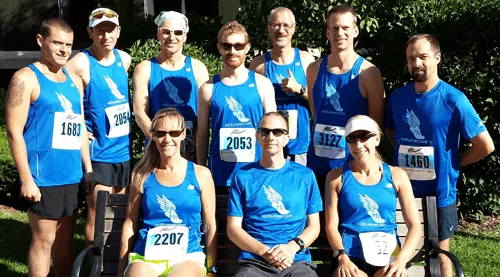
What a good looking team!
As most of the regulars here already know, Al’s Run in downtown Milwaukee is the big event for Team HillRunner.com every year. In fact, in recent years, it’s been the only event. I always get very excited about this event. Especially since I left Waukesha, it’s often my one chance a year to see many of the great members of the HillRunner.com community who live in the Milwaukee area and throughout south and east Wisconsin and even north Illinois.
This year was no different. In fact, if anything, I was even more excited than usual for this year’s event. As well as seeing familiar runners like Double, Cameron, Woody and Ed, there were three new team members (Laura, Steve and Tim) I was excited to welcome to the team and there were team veterans who couldn’t join the team last year but who were returning (Charlene and Rick) who I was happy to welcome back. Of course, I was also there to run. In addition to this, though, everyone on the team had requested a team uniform and I was very excited to see the new team uniform debut 10 strong near the front of the field at Al’s Run. I was also happy to see some discussion of pack running. We seemed to have two primary packs forming. One would be four strong looking to run in the mid-28s and the other would be three strong looking to run between 30 flat and 31 flat. Not only do I love team running, teammates feeding off each other’s energy, pulling each other along and battling it out together, but how cool would it be to see teammates wearing the blue to be packed up together along the course? That had me really excited to not just be running but to see teammates to run with during the race and to see pictures later with teammates working together.
After a team warmup, I got to my usual starting place on the line (on the left side of the median) and saw Woody. Everyone else seemed to be on the right side of the median. I prefer the left side because it’s less crowded and a slightly shorter route if you run your tangents right. Woody took off to the right side, saying he was going to let people know that the left side would be better but, just after he went, the one minute warning was given. It was time to line up. I felt there was nothing I could do at that point but take care of myself. With about 10 seconds to go, we got called up to the line, I toed the chip mat that was serving as a start line and listened for the countdown. I was feeling good, some foot and lower leg problems I had been experiencing weren’t even a thought, and I was ready to go.
As the race started, I got out well and was leading or in the top 2-3 on the left side of the median. There was a pack out ahead of me on the right side. Pretty much the usual situation. I took extra care to make sure I just eased into mile 1. This mile is mostly made up of a long, gentle downward grade toward the Milwaukee River. After the river, you go up a little before hitting the mile mark. It’s also right through the middle of downtown Milwaukee so you’re pretty sheltered from both the wind and the sun, making it a pleasant feeling mile. The one catch I’ve found to this mile is that it’s easy to go too fast. You’re amped up for this large race, there is a good number of runners ahead of you and that gradual decline lulls you into running faster than you realize you are going. So I was focused on being quick but very relaxed.
Late in mile 1, I had Rick on my right and Tim on my left. I couldn’t help but think how cool is this. Three teammates in uniform running shoulder to shoulder or in a slight V formation near the front of a large race through downtown Milwaukee. That is just awesome! I also found myself thinking about Steve. I didn’t see him around but I was hoping he was right with us. I would find out later he unfortunately wasn’t but it was still great to have three of us cruising together. We did cruise together right through the mile mark. I don’t have an exact split but I heard a split of 5:35 called just after we passed. Probably 5:33-5:34.
Into mile 2, we start the gradual climb away from the river. In the past, I’ve tried hard to maintain pace in mile 2 and that usually came back to bite me in miles 3 and 4. This time, I decided I’m just going to settle into a good rhythm and take what mile 2 gives me. I’d save the big efforts for the last 3 miles. Shortly after turning toward the north at the east end of Wisconsin Avenue, it felt like Rick wasn’t there anymore. Not too long later, up an incline that I just had no interest in pushing, Tim gapped me. I just let him go and figured I’d try to catch up with him in miles 3 and 4.
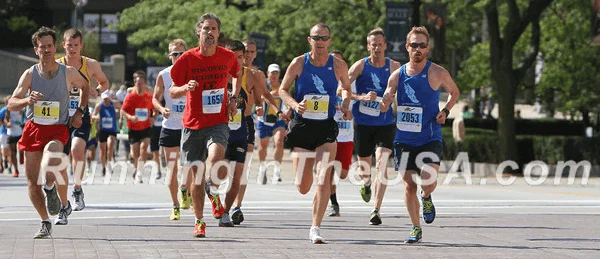
Mile 2: Nice teamwork! (courtesy RunningInTheUSA.com)
The rest of mile 2 just played itself out. I found a nice rhythm and watched the runners ahead of me, Tim included, planning to pick the effort back up in mile 3 and bring them back. I hit the 2 mile mark in 11:35 for a split of about 6:01-6:02. Wow, that was a bit slower than I expected. As soon as the math registered in my head, I told myself heck no and picked up the effort. Ever so gradually, I began making up ground on Tim and some other runners. To be honest, other runners more than Tim. We both were moving through the field a bit in that mile.
Mile 3 ends by going down Lafayette Hill. For those who don’t know Milwaukee, this is a hill that leads you down the bluffs from the residential neighborhoods overlooking the lake down to lake level. It’s a fairly steep and not extremely short downhill. I’ve always been a good downhill runner so I set my sights on all 3 runners who were ahead of me at this point, the last of whom was Tim. I made quick work of the first two, who started down the hill just steps ahead of me. Then I set out for Tim, who was a little further ahead. Near the bottom of the hill, I caught him and tried to say something encouraging, "Let’s go, hammer time" or something along that line, as I know mile 4 is one that can be really good if you’re aggressive or really bad if you let it wear on you. I wanted both him and myself thinking aggressive.
I rounded the corner and hit mile 3 in 17:12. Back to 5:37 for mile 3. That’s some good work in a somewhat challenging mile. Now, time to do some more good work. This mile for me is the time to lay it all out on the line. I always will find a way to get through the final mile but, if I’m not attacking and really pushing to my limit in this mile, it can get the best of me. The field is pretty spread out by this point but I just go to work, one runner at a time. My memory is a little fuzzy on this but I probably passed 2-3 guys in this mile and found myself gaining on a guy with a black and white singlet as we approached mile 4. I was getting really close to him but he seemed to be responding to some extent. He was not going to be an easy pass.
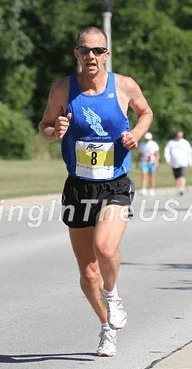
Late in mile 4: Did I mention I laid it all on the line in mile 4? (courtesy RunningInTheUSA.com)
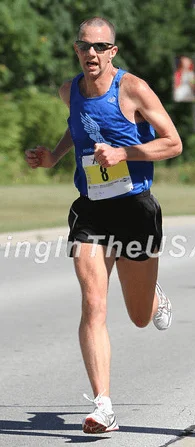
One more from late in mile 4: This is fun, right? (courtesy RunningInTheUSA.com)
I completely missed the mile 4 split as this guy, apparently a UW-Milwaukee student, was passing some walkers with UWM shirts and they were cheering him on. He riled up the crowd on the pedestrian bridge that goes to the art museum and I stole a little of that energy to feed off of as I pushed ever so slightly closer. Around a right turn, then I caught him and gave it everything I had to put him away immediately so he couldn’t come back in the kick. He gave me an encouraging word, I was already breathing so hard I was grunting for at least a half mile at that point so I couldn’t respond. I just poured it on. There was another guy ahead but he wasn’t that close so I kept pushing to get as close to him as I could even though I knew I wouldn’t catch him. Around a left, a right, then another left, I kept reminding myself to not look back. I wanted to look back so badly to see if I had built up a suitable lead but I didn’t want to show any sign of weakness so I kept my eyes forward and kept driving, harder and harder, not wanting this guy to pass me back in the kick. One more left turn and I can see the finish line. I’m trying to read the clock but more focused on just driving as hard as I can. As I approach about 100 yards to go, I try to sprint. Drive the arms, push off as hard as I can, get the turnover as high as I can. My pace changed ever so slightly but it probably looked less like a kick than like the flailing final effort of a guy who was incapable of sprinting. Pure coincidence I’m sure. I got myself to the finish line without letting anyone pass me, then after stopping turned back to see Tim already across the line. It turned out he put up a good battle with that UWM runner but came up just short. Still, he ran tough and finished very well. It was great to have a teammate right there with me essentially the whole way.
Then I scanned for Rick and Steve. We were expecting them to also be in the 28 minute range but there was no sign of them. Tim and I started walking back up the course some to cheer our teammates in. Rick came along just as the clock was ticking toward 30 minutes. I had him right about 30 minutes flat. Then came Jerry shortly after him with Steve right behind. Our top 5 were all in by about 30:30. Next in was Woody, just over 31 flat, with Double close behind. Ed came in just under 32 minutes for another nearly 30 second PR, then Charlene came in about 30 seconds behind Ed. Laura rounded out our finishers with a very solid effort 6 days after running a draining half marathon in the heat and humidity and we began grouping up just past the finish line.
As several of us were cooling down together, chatting about the race, I couldn’t help but think about how great this team was. While a couple of us went home disappointed, from top to bottom, we all were top level competitors and I was proud to see these 10 people wearing that cool HillRunner.com singlet and representing this site so well. I still get chills thinking about this. These 9 people were willing to wear the blue and represent this place that I started so many years ago and has evolved into such a great online community. I’m truly blessed to have these people around me who are so willing to represent this site with so little given back to them in return.
The team as a whole got 3rd in the community division, only 1:43 behind the first place team. Seeing as we got moved to the more competitive community division, I think this is a great result. I also think it gives us a goal for next year.
The final results for the team are as follows:
  3. HillRunner.com

  1    28:23   Ryan Hill

  2    28:24   Tim King

  3    30:01   Rick Smith

  4    30:24   Gerald Cameron

  5    30:33   Steve Tietz

================================== 2:27:45 (  29:33)

  6    31:08   Marc Woodcock

  7    31:21   David Dehart

  8    31:54   Edward Pankow

  9    32:28   Charlene Larson

 10    38:41   Laura Walsh
I can’t thank the team enough. This was a very special year for me, to see such a great group of people out there, all wearing the blue, having fun and running hard meant a lot to me. I still get chills thinking about some of the moments from Saturday.
Afterward, some team members were able to make it out to my place for a cookout. That was the least I could offer for all they did for me that morning and it was great to sit down, not wearing our running gear, and just have a casual chat with such a great group of people.
I think most team members went home happy with their performances at the end of the day. A couple were disappointed but I believe still put up great efforts in the face of adversity. I hope all can make it back again next year and maybe we can even expand the roster. Once again, thanks to these 9 wonderful people who were willing to represent HillRunner.com and did such a great job of doing so! I hope everyone here is as proud of them as I am.
If anyone else wants to share their own stories or pictures, feel free to either add them to the comments here or create a separate blog post.
