Summer schedule

This article was originally posted by Ryan at the original HillRunner.com Blogs.

As I often say about our running, we need to balance our priorities.

I’m taking my own advice this summer. Living in Wisconsin, I need to take advantage of the summer weather while I can. I’m going to be giving myself more time to enjoy time with my family. Camping trips, trips to the park, evenings outside playing and so on. As a result, I’m going to go to a summer blogging schedule of one post a week, on Thursdays.

I’ll try to mix up the posts with some of the roundups that you normally see on Mondays and some of the original posts that you normally see on Thursdays but, to be honest, there will probably be more roundups.

I hope everyone understands and I hope everyone has a great summer. Monday posts will return on September 14, after the Labor Day weekend.

Ask me anything

This article was originally posted by Ryan at the original HillRunner.com Blogs.

Image

I did this about a year ago and about 6 months ago. Let’s make it a tradition to do this twice a year. Here’s your open invitation to ask me anything.

If you want to ask publicly, you can do so in the comments, on Facebook or you can tweet at HillRunner.com (or tweet at my personal account). If you want to ask more privately, you can use the contact form or, if you’re friends with me on Facebook or you know my email address, you can reach me through those options.

Within reason, nothing is off limits. Ask about training, racing, my thoughts on any news in the sport. Ask about the site, the coaching service, the new Club HillRunner.com or anything else that’s going on.

So, please let me know, what have you been thinking about and wanting to ask?

Gluten free diet for the non-celiac and why do older runners struggle more in the heat?

This article was originally posted by Ryan at the original HillRunner.com Blogs.

Gluten free diet for the non-celiac

I’ve noticed that quite a few people over the past few years are going toward gluten free diets, even if they are non-celiac. The belief apparently is that, even for non-celiacs, there are benefits to avoiding gluten.

Well, maybe not:

A short-term GFD had no overall effect on performance, GI symptoms, well-being, and a select indicator of intestinal injury or inflammatory markers in non-celiac endurance athletes.

As usual, more study is needed. However, at least in the short term, this study suggests no benefit in any regard that was measured. Seeing as I’m not aware of any studies that suggest otherwise, at this time at least, I’m going to keep having my gluten.

Why do older runners struggle more in the heat?

We’ve known for some time that older runners seem to get hit harder by the heat than younger runners. What I haven’t noticed much on, though, is why. This is an interesting question because, if we understand why, maybe we will be able to find some ways to lessen the effect.

Well, this was spun as informing us that older runners do struggle more in the heat but another part caught my attention:

"[A]ge was the only variable to significantly correlate with whole-body sweat rate," the researchers wrote. "This would suggest that when the stimulus for sweating is equal for all participants … aging may have a larger influence on whole-body heat loss capacity than the fitness level or specific physical characteristics of the individual."

So our sweat rate declines as we age, even independent of variables that we usually think of as affecting sweat rate such as fitness or body fat percentage.

Knowing that sweating is our primary way to dissipate body heat, this is a big deal. Next up: why does our sweat rate decrease as we age? It appears we don’t yet have an answer to that.

Club HillRunner.com open for early sign-up!

This article was originally posted by Ryan at the original HillRunner.com Blogs.

Image

Have you been looking for more at HillRunner.com? Have you been looking for a way to support HillRunner.com without signing up for coaching?

I’ve been hearing just these things from some of you. You’d like to see videos, you’d like more tips, you’d like a closer, more tightly knit community. Some of you have even been generous enough to say you’d like to support HillRunner.com financially but you don’t feel the need to sign up for coaching. That’s why I’m starting Club HillRunner.com. To meet all of those requests.

So what is Club HillRunner.com? To be honest, I picture the club as the community of runners who sign up. However, let’s talk about what this community can expect to see.

What can Club HillRunner.com members expect to get?

To start out, there will be three primary benefits of joining Club HillRunner.com:

1) Membership in a private Facebook group: This is a group where I will share weekly tips that I don’t share publicly elsewhere. I also share links to interesting articles when I have too many to blog about and I hope to see it grow into a community where we can share in our experiences, support each other and ask and answer questions in a more private setting than we can elsewhere.

Image

Every week, you will find a tip that is posted just to the group. From training tips…

Image

…to advice on form and everything in between.

2) Exclusive access to a library of training videos: The library isn’t yet set up but will be before Club HillRunner.com officially launches on July 1st. This will be a place to find short instructional videos on a variety of things, from strength training exercises to form drills, stretches and tips on running form. I’m sure it will also include a few other things of interest as the library grows.

3) The HillRunner.com SuperCalc: Have you ever used the HillRunner.com calculators and found yourself wishing the functions of two or more could be combined into one? I know I have so I did something about it. I created the SuperCalc, which does just that. Simply enter a recent race result and you can get information on equivalent race performances, suggested training paces and more all in one place. Even some things that aren’t available in the currently available calculators.

Image

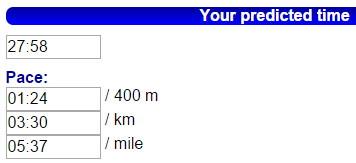
The SuperCalc combines the best of the HillRunner.com Calculators into one easy to use tool. It can predict your performance at any distance you would like, given a result at another distance.

Image

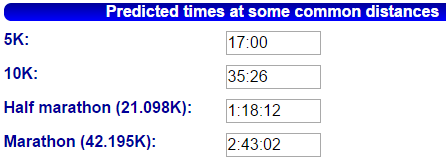
At the same time, it will give you equivalent performances at some commonly run distances.

Image

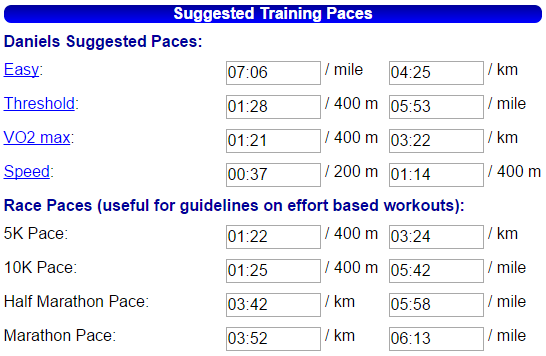
It will even help you find recommended training paces in the same place.

Keep in mind that more benefits will be coming in the future. For instance, I have some ideas to improve the training log that will be made available first to Club HillRunner.com members before they are made available publicly.

Finally, you’ll be supporting HillRunner.com financially. Some of you have asked about donating to the site. I appreciate the offers but I’ve never felt right accepting donations without offering something in return. So this is what I can offer. If you want to support HillRunner.com, this is how you can do so and get something in return.

Signing up is easy and inexpensive, especially if you do so soon! Right now if you sign up, you can get membership good through the end of June 2016 for just $10. Just follow this link to find sign up information.

Note: If you are receiving coaching from me, you are already a Club HillRunner.com member. No need to sign up!

If you have any questions about this new offering, please don’t hesitate to ask.

Beet juice for the brain, pre-exercise dynamic stretching

This article was originally posted by Ryan at the original HillRunner.com Blogs.

Beet juice for the brain

You’re late in a race. Maybe you’re running a 10 miler, shooting for 80 minutes, and you just went through 9 miles in 1:11:34 after going through mile 8 in 1:03:42. Quick. How much time do you have to cover the last mile and is that faster or slower than you covered the prior mile? Right now, that’s easy to answer. You know as well as me that it would be a far different story if you were trying to do the math during the race.

I’m sure we’ve all heard about the likely endurance benefits of beet juice and its key ingredient, nitrate (also found in dark leafy greens and some other foods). What if there were another benefit?

Well, Alex Hutchinson finds a study that points to another potential benefit.

When you’re exercising hard and hyperventilating, levels of carbon dioxide in your blood drop, which can in turn cause your blood vessels to constrict, reducing the amount of oxygen reaching your brain. The nitrate in beet juice, which is converted to nitric oxide, plays a crucial role in dilating blood vessels, so it may counteract this effect.

That’s just a hypothesis right now. However, with those taking beet juice able to respond to a cognitive test more rapidly, there definitely appears to be some benefit.

Pre-exercise dynamic stretching

What do you do in regards to stretching or mobility exercises before workouts or races? Nothing? Static stretching? Dynamic stretching? There is plenty of debate as to what kind of exercises are good to do pre-exercise or whether it’s best to do none.

In the battle of none vs. dynamic, let this be a vote in favor of dynamic:

The results demonstrated that the DS [dynamic stretching] treatment improved the endurance performance of running at a velocity equivalent to 90% VO2max in well-trained male runners, although it did not change the RE [running economy]. This running velocity is equivalent to that for a 3000 or 5000 meter race. Our finding suggests that performing DS during warm-up before a race is effective for improving performance.

This is when compared to non-stretching. I’d definitely consider this pretty significant. Time to exhaustion at 90% VO2max was significantly longer on average and total running distance was, on average, nearly 700 meters longer (just over 4301 meters vs. just short of 3617 meters). That’s a result to pay attention to.

Scroll to Top