
Another honor for Coach Conway

This article was originally posted by Ryan at the original HillRunner.com Blogs.
Image

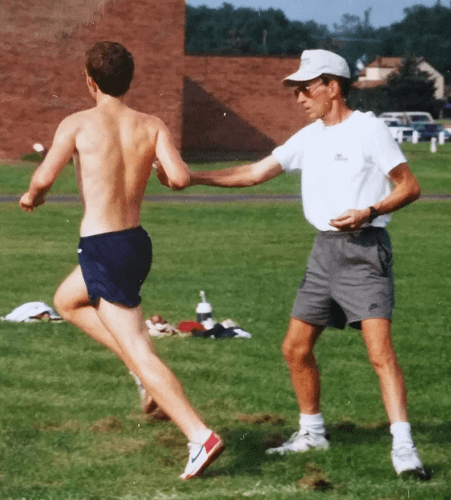
Coach Conway – inspiration, role model, mentor – working the finish line, one of the many jobs a high school coach fills

A personal post this week. As anyone who knows me as a runner knows, my middle school track and high school cross country coach has been a huge influence on my life. To be honest, he has been inside and outside of running.

To explain what Coach Conway has meant to me would take far more words than anyone wants to read in a blog post. To try to keep it short, I highly doubt I would have found my way to distance running without him and it’s no secret how big a part of my life running is. He has done much more for me, though. He taught me to be confident in myself, to be proud of what I’ve accomplished while remaining humble. He’s been an amazing role model on many levels, from the way he freely shares his incredible wealth of knowledge to his work ethic and desire to excel personally as well as be as helpful to as many others as possible.

Coach Conway’s accomplishments have rightfully garnered him many honors. As an athlete, he’s a member of the Indianhead Track Club Hall of Fame and the USATF Masters Hall of Fame (class of 2007). As a coach, he’s a member of the Wisconsin Cross Country Coaches Association Hall of Fame (class of 1998). I had the extreme honor of being his invited guest to the induction ceremony for the Wisconsin Cross Country Coaches Association Hall of Fame. I couldn’t have been more proud to sit there next to him as he was granted that honor, not just for coaching state champion athletes but also for coaching runners like me to be the best runners – and people – we can be.

Well, I just found out that Coach Conway is being inducted into another hall of fame. While he would likely never admit it, a lot of people who know him would agree with me that he can’t win enough of these honors. He deserves all he gets and many more.

Since hearing this news, I’ve been thinking about Coach Conway a lot again. How much he means to me and my life but also how many others out there have had their lives forever shaped in wonderful ways by his guidance. Coach Conway is the reason I started HillRunner.com, the reason I decided to take up coaching and the reason I do everything here. He gave me so much, in so many ways, through running that I wanted to do something to give a little back. I wanted to pay it forward in any way I could. If I can help even one person even half as much as he has helped me, I know I’ll have made this world a better place.

In the meantime, congratulations to Coach Conway! I couldn’t ask for a better inspiration, role model and mentor.

This week’s post is all about pain…???

This article was originally posted by Ryan at the original HillRunner.com Blogs.

I hope nobody gets the wrong impression. I really don’t think running should be such a painful thing. That said, I have two pain related topics for today. Gender specific injury prevention and our memories of painful events.

Gender specific injury prevention

This seems like an interesting topic to me. Let’s be honest. As much as I love the sport of running because it’s so open to all people, all ages, all genders, men and women are different even when it comes to running. There are some differences in our physiology that simply can not be overlooked.

How might those differences affect our susceptibility to injury? Well, Alex Hutchinson came across an interesting study on that topic.

Comparing within each sex, the injured female runners displayed greater hip rotation than healthy female runners. The same pattern didn’t show up in men, though; instead, injured male runners had greater ankle rotation than healthy males. So while the end result is the same, “females develop this injury from a hip-down perspective while men develop it from a foot-up perspective,” Ferber says.

Now, that’s an interesting result. The suggestion was that women should focus on hip strength to reduce injury risk while men should focus on foot and lower leg strength. I’d suggest that all runners should pay at least some attention to all these areas but it may be worth considering where an additional focus is given if you have a history of problems.

Our memory of pain

Think back to your last marathon. If you haven’t run a marathon, think back to your big race last year. What do you remember? The accomplishment? The sense of achievement you felt when you realized you hit your goal? Oh yeah, it hurt some also, didn’t it?

I suppose this shouldn’t be surprising but you probably have forgotten more about the pain than about the accomplishment.

In short, that’s exactly what happens. You remember the sense of accomplishment. The memory of the pain it took to get there fades.

What can we do with this? The article suggests trying to associate the pain during a race with the sense of accomplishment that is coming at the end because that’s what your future self will do. More practically, I’m not sure but it’s interesting to think about and I thought worth a share.

Haile Gebrselassie has retired from competitive running

This article was originally posted by Ryan at the original HillRunner.com Blogs.

Image

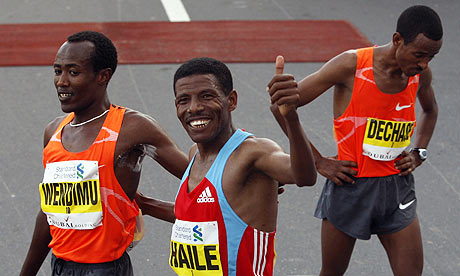
I will always remember both the ferociously competitive spirit and the huge smile

In case you haven’t already heard, the great Haile Gebrselassie has officially retired from competitive running. He says he will keep running and will remain involved in the sport but he is done competing.

As many runners of similar age, I grew up as a fan of running watching and cheering for Geb. Actually, I was split between Geb and Paul Tergat, his chief rival through most of the 1990s on the track and into the 2000s, first on the track and then in the marathon. Off the top of my head, I can’t think of a better two person rivalry in distance running history. Geb always seemed to have the upper hand but Tergat was always there From trading world records to the legendary 2000 Olympic 10,000 meter finish, they were always neck and neck.

Beyond the amazing competitions and times posted by Geb, though, I will also always remember that broad smile you can see in the image above. He always seemed to be friendly with everyone and truly love what he was doing. His enthusiasm for running and for the spirit of competition was amazing.

For all that you have done for the sport and for the great inspiration you have been for so many, thank you Geb. You are a true living legend.

What makes a champion?

This article was originally posted by Ryan at the original HillRunner.com Blogs.

Image

Last year, I listened to a TED Radio Hour podcast episode titled Champions. I wanted to write about it at the time but never got around to it. That episode ran again last week and I’m not going to let it slip by again.

In the podcast, the host interviewed three speakers, two athletes and a sports journalist. All had some interesting comments on what makes a champion. I highly recommend listening to the whole episode but I’d like to highlight a few points raised.

From Diana Nyad (first person to swim from Cuba to Florida without a shark cage) on what makes a champion:

The fear of failure is stronger, more motivating, than any other fear they’ve got.

What a great answer! They don’t let anything stand in their way because their biggest fear is not accomplishing the goal.

What can we take from this? Well, we may have fears that are greater than our fear of failure. Not everyone is trying to swim from Cuba to Florida or become an Olympic champion and that’s fine. However, I always think of the Michael Jordan quote here:

I’ve missed more than 9000 shots in my career. I’ve lost almost 300 games. 26 times, I’ve been trusted to take the game winning shot and missed. I’ve failed over and over and over again in my life. And that is why I succeed.

If we put ourselves out there, we’re going to fail. Fearing that failure will hold you back from taking the chance at success. Sometimes you have to take risks. Of course we need to consider the pros and cons. I’m not telling you to show up at the Boston Marathon next year and run with the elites because you no longer fear failure. However, be willing to take a chance. Push the pace a little harder than you normally would at your next race. Challenge someone you always seem to finish right behind. You can’t succeed without risking failure.

From David Epstein (sports journalist and a great speaker and writer – I highly recommend his talk and reading some of his other work) there were several interesting topics but I’d like to focus on this one:

Actionable goals: Set more proximate goals that tell you what you need to do today.

There were other parts but I’m going to focus on this. Listen to his whole talk because there is a lot of good material in there.

What can we take from this? We all (hopefully) have goals for our next race. Those are great and we need to have those goals. However, we also need to have more immediate goals. What are you going to do today to get to that longer term goal? Think about that every day when you wake up.

Also good advice for other parts of your life.

From Amy Purdy (amputee snowboarder, Paralympic medalist):

Instead of looking at our challenges and our limitations as something negative or bad, we can begin to look at them as blessings. Magnificent gifts that can be used to ignite our imaginations and help us go further than we ever knew we could go. It’s not about breaking down borders. It’s about pushing off of them and seeing what amazing places they might bring us.

Another great line! I love this!

What can we take from this? I know it may seem a little cliche but try reframing "obstacles" as "opportunities". At the very least, don’t let an obstacle block you. Find your way around. If possible, catapult off that obstacle and find a way to use it as a positive.

For example, you can’t run in the evening because you have to practice soccer with your child. Why not turn this into a training opportunity? Get some running in. Practice some agility drills that will improve your strength and neuromuscular coordination, making you a better runner. Maybe the run can happen in the morning and the evening soccer session with your child becomes a second training session.

We can’t all be Olympians or do amazing feats that seem impossible to the normal person. However, we can take ideas from the people who are doing these things or have achieved those levels of greatness and apply them to our lives. Above are just a few things we can take from this episode to make ourselves better, in and out of running. Listen to the episode and you might get even more ideas. I know I did.

Eau Claire Half Marathon

This article was originally posted by trivianut at the original HillRunner.com Blogs.

If anyone wants to run a really well organized race, I would recommend this highly. I had the chance to run it on Sunday with my daughter. She had been trying to get me to run this throughout her tenure as an undergrad at EC, and we finally got it done. She wanted to run under 2 hours and I thought that was doable. Several things were against us though. It was unseasonably warm for NW Wisconsin, with a high of 83. Added to that was the fact I wasn’t the greatest pacer, and her lack of training did her in a bit. But we went after it, with her mom and brother and all her sorority sisters cheering us on at various points during the race. Our first 5 miles were about 8:40 pace, pretty much right on. It felt really slow to me, but Megan said she was ok. She began to struggle at that point, and she was not sure she was going to be able to finish. I told her whatever pace she could handle was fine, we would get through it together. We did a bit of walk 1-2 min run 10 min cycles. Then I had to make a pit stop and it took about 10 minutes to find her and catch up. When I did reach her I could tell she was laboring even more, and our overall pace dropped below 9 min. Then the 2:00 hour pacer passed us, and she was still struggling. This was very weird for me, because I felt good. But I began to understand that it wasn’t about me. My daughter, who rebelled against any running advice from her dad during her high school career, needed me to get to the finish line. We saw her mom and brother at the 11 mile mark, and then the gauntlet of sorority girls 5 minutes later gave her a momentary energy boost. But we were walking more frequently and for longer periods. I got a bit harder on her, challenging her to keep moving forward. Finally I knew we had just 1/2 mile, and we turned into Carson park to see finishers walking back towards us. She saw a women with a finisher’s medal around her neck – pointed at her and said " I want that!" So I said ‘then let’s go get it" We did run steadily to the end, and finally she kicked it in at the finish. 2 hours and 6 minutes after we started, we cross the line together. It was a great moment for me as a father. Megan was pretty spent the rest of the day, but you could tell she was really happy. She wouldn’t take the medal off. And I had run my longest run in perhaps 7 or 8 years. As I mentioned at the beginning, nothing but good things to say about this race. Well organized, wonderfully scenic course, and the best spectators I have experienced in 35 years of running races. Maybe next year I could come back and run again, but alas, our daughter is graduating and moving out of state to Minnesota to become a Nursing Home Administrator. I am very proud of her for many reasons, and yesterday was but one of those. Ryan you said you’d love to have that opportunity to run with your kids, and I truly hope you do. It was one of the best days of my life. Now my 24 year old son wants to run the Madison Mini (13.1) in August. Of course, I’d love to run at MY pace this time. We’ll see how that goes….

Scroll to Top