
Lactate is NOT that bad, more on carbohydrate mouth rinses

This article was originally posted by Ryan at the original HillRunner.com Blogs.

A couple interesting things I want to point to today. One on that old boogeyman, lactate. Another on the idea of rinsing your mouth with a carbohydrate drink after exercise.

Lactate

For decades, lactate has gotten a bad rap. While some of us have known for years that lactate isn’t the boogeyman that it’s been made out to be, it can actually be used as a fuel for one thing, it still has that bad rap.

To be clear, when your muscles are sore the day after a hard workout, that has nothing to do with lactate. Once your workout is over, lactate is cleared from your body very quickly as it is used for fuel or converted to other substrates that can later be used for fuel.

Let’s take a look at another myth: the myth that lactate causes fatigue:

These results suggest that blood lactate appears to have a protective effect against fatigue, at least at level of primary somatosensory cortex, although at the expense of efficiency of adjacent areas.

So let’s stop hating on lactate. It’s not all good but the bad rap it gets in many circles is almost totally unwarranted.

Post-workout carbohydrate mouth rinses

In recent years, we’ve seen some interesting results from studies testing simply rinsing your mouth with carbohydrates before a hard workout or race. You apparently don’t even have to swallow. Just rinse with the carbohydrates and your body responds by assuming that more fuel is about to be available and makes more fuel available for use. That’s a good thing in shorter races where we’ll never tap into our complete stores.

What about post-workout, though? Does simply having carbs in your mouth, even if you don’t swallow, have a benefit?

It appears the answer is a qualified yes:

These data suggest that CHO mouth-rinsing attenuates neuromuscular fatigue following endurance cycling. Although these changes did not translate into a performance improvement, further investigation is required into the role of CHO mouth-rinse in alleviating neuromuscular fatigue.

No performance improvement found here so maybe the benefit isn’t functionally useful. However, it’s interesting that there was a reduction of neuromuscular fatigue. I’ll be interested in watching for some follow-up to this.
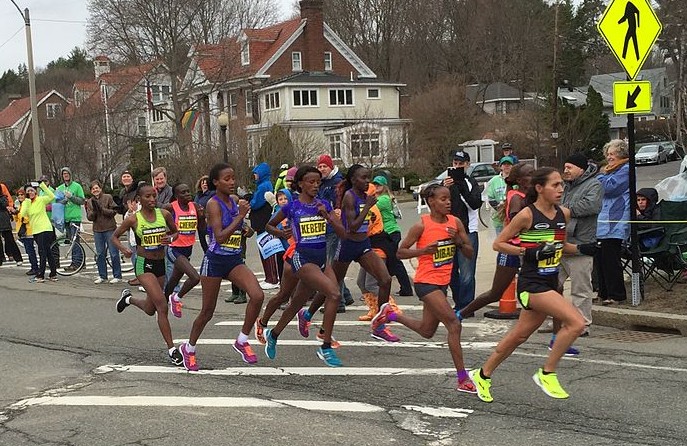
Larry Rawson’s weight comments at the Boston Marathon

This article was originally posted by Ryan at the original HillRunner.com Blogs.

Image

Lightweight? Yes. Also and more important: powerful, extremely fit, amazing stamina.

Did Larry Rawson do a disservice to young and likely not so young runners across America? In my opinion, yes.

I didn’t see the coverage live. I saw a lot about the topic as it was happening via Twitter, though, and it reminded me of previous races I did see live where Rawson constantly focused on the weight of the elite female runners. When I saw some replays of the race, I heard at least some of his comments and heard what I feared but also expected given his history.

During the race, as he has done during other races, Rawson repeatedly references the weights of certain members of the elite women’s field. He at times seems fixated on their weights, as if the weight of the runner is the most important factor in the race.

What does this do to the high school runners watching the race who want to emulate these runners? When a commentator focuses this much on the weight of the runners, it will appear to some who are watching that weight is the key to their success.

The truth, as is obvious to most of us who will read this, is much more complex. Yes, weight matters. There’s a reason 150 pound women and 200 pound men aren’t winning major marathons. However, there’s much more than just weight.

I would argue that even more important than weight is strength (or power) to weight ratio. Obviously, also, aerobic and muscular endurance. Efficiency also matters. As do various other things that are too numerous to list.

We already have a problem in this sport. Some ill informed coaches and others who young runners, especially girls and young ladies, take advice from already place way too much importance on weight. Eating disorders are a problem for too many runners. I’ve seen the damage eating disorders can do. While these disorders are complex, focusing too much on the weight of the elite runners surely doesn’t help.

Before he does this again, I would ask Rawson what kind of message he wants to send.

Nutrition

This article was originally posted by cesar at the original HillRunner.com Blogs.

Hey,

I have been very consistent with my trainig, but my diet is terrible, i am 192 pounds and when I ran my best times I was about 155-160 pounds, so I think the only way that I ll run that fast again is in that weight.

Could you please put an example of the food and snacks that you eat on a daily basis, do you eat junk food here and there?

Thanks a lot

Become a writer

This article was originally posted by Ryan at the original HillRunner.com Blogs.

Just one link this week but I think it’s a very good one.

We’ve probably all heard by now about the importance of keeping a training log. I hope we all are keeping a training log.

In addition, have you considered writing before a race about not just your training but also your upcoming race? Especially if you’re nervous about the race, it could be helpful.

This article about writing about your running makes a good case for writing more about your running.

It covers the training log aspects. The idea of reviewing your training to gain confidence in the work you have done, seeing where your strengths and weaknesses lie and so on.

In addition, it puts a real focus on writing about your race ahead of time. By getting your aspirations, apprehensions and other feelings about a race down on paper (or, I suppose, pixels) before the race, I believe that allows you to deal with your emotions ahead of time. As mentioned in the article, it also allows you to remember what your goals are, why you set those goals in the first place and plan out the best strategy, including backup plans in case something doesn’t go as originally planned, to accomplish those goals.

Writing out your plans and reviewing your logs also allows you to ensure your goals truly fall in line with where you are in your training. Maybe you find that your original goal was too aggressive and you can back off it a little. Or it was a little too conservative and you can bump it up a little.

So, if you’re not keeping a training log right now, what are you waiting for? Get started! If you are, great but are you doing more? Try writing down your goals and your plan to accomplish those goals before your next race.

Crazylegs

This article was originally posted by trivianut at the original HillRunner.com Blogs.

This is the largest road race in Wisconsin, with 10,000 runners. There are some similarities and differences to Al’s Run. They’re both 8k races, with large fields and plenty of competition. The main difference is Crazylegs has a wave start, based on predicted time. Waves of 200 runners go off every 30-45 seconds. My estimated finish time of 38 minutes put me and my son in wave G. On the one hand running around a bunch of slower runners in waves that went off earlier was a bit frustrating, and it meant that the course was always full of runners. The benefit for me was it allowed me to focus on my effort and not get sucked out into too fast of a pace. Plus I always had people to focus on and pick off. The course winds from the Capitol down to campus, along lake Mendota, and then returns to finish inside Camp Randall stadium where the badgers play football.

Having no real idea where I might finish (35-38 minutes I was guessing), I focused on a hard steady effort. My splits were pretty indicative of that, with the possibility that I had more to give with the last split…

7:05

7:05

7:21

7:22

6:40 (.97)

Overall 35:33, 606 out of 10,000, 21 out of 444 in 50-54 AG

I was really happy with the result, since my last race (Al’s Run) was frustrating with the ankle turn. My training has focused on just getting out there 5-6 days a week, 5-6 miles a day. No special runs or speed workouts, and I am running a half marathon next Sunday so I didn’t want to hurt my recovery. I’m running the half with my daughter most likely, so my time will be slower. At 51 I do recover more slowly from workouts in general, and I’m careful about my balky right knee, so I plan continuing with the steady runs an will try to add a bit more mileage as the warmer weather comes.

Scroll to Top