Ryan

Race report: 2017 Gary’s Gallop

This article was originally posted by Ryan at the original HillRunner.com Blogs.

This winter, I hit another age group as I turned 40. Seeing as I have little to no interest in racing during the winter these days, I wasn’t sure what race would become my first in this new age group. At first, I was thinking of the Legal Run Around in Fond du Lac but things just didn’t work out for various reasons.

As I was looking over my schedule and what I had in mind for late spring/early summer races (one too close to home to pass up and another that’s a favorite of mine and I have to correct a wrong from last year at) I realized Gary’s Gallop fits into the schedule perfectly. So that’s where I found myself this morning.

As it turns out, though, I completely wasted the opportunity of my first race in this new age group.

I arrived at the Wisconsin Lutheran College athletics grounds a little unsure of what today would bring me. I had a decent but not great winter of training. I feel I’m fit. By the end of this week, I’m feeling as healthy as I’ve felt in at least a couple months. However, I’m not yet race sharp. High level of general fitness, low level of race specific fitness. Of course, that’s what you expect at the first race of the year, right?

On top of that, I had some things going on this week that had me a little off my game. My refrigerator stopped working and we can’t get a new one delivered until next week. So, along with the stress and hassle of dealing with that, my diet has been thrown for a loop as we’re trying to avoid any food that would need to be cooled. I also have several things going on that just had me more busy than I usually like on a race week. So I wasn’t quite sure how great my energy levels would be.

That said, I was there to race. I’d do the best I could, whatever that meant. So I checked in and got ready to warm up.

I was originally planning to warm up on the course but, when I got past the start line, I quickly realized a gate about 100 yards in was still closed. So I detoured onto the track and did my warmup there. I have to admit I didn’t feel too springy on the warmup but I was getting things worked out and feeling at least a little better.

At the start, I was eyeing the competition. It looked like a few good runners but nobody I could pin as someone who would surely run away from me without a problem. Whatever the case, this was going to be a day of pure racing, not time trialing. This course doesn’t have ridiculous hills but it is undulating with a general downhill trend early and uphill late. Combined with a fairly stiff second half headwind, this was a day for real racing.

At one point, I overheard a conversation where someone asked a friend if another of their friends would be winning. “Yeah, of course” was the answer. That kind of rubbed me the wrong way. I sure didn’t see anyone who looked to warrant that sure of a statement. Oh well. If pre-race prognostications were always right, we wouldn’t need to run these things.

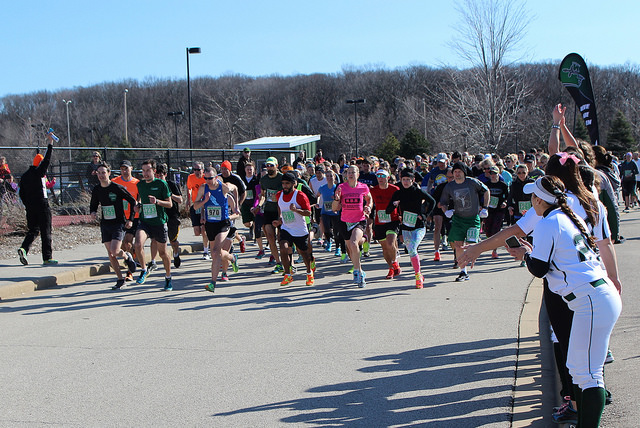
I lined up next to the two guys I pegged as the most likely lead competition. I was wrong. At the gun, I found myself right behind one of them as he acted surprised to be in the lead. Down a slight decline, I took the lead and picked up my police escort. It’s been a long time since I had a police escort so I thought for a moment how fun that was. Then I focused on getting a read for who was behind me. I could tell someone was there, I didn’t think it was the guy who started out in the lead but I couldn’t be sure until he pulled up next to me and I could see he wasn’t.

For the first mile, we were back and forth. At times, I’d get maybe a half step lead. At times, especially up one of those inclines, he got a one step lead. We were always right there, though.

We were being given splits everywhere. I heard a 4:05 and jokingly said I sure hope that’s not the mile split. As it turns out, I believe I heard 5:45 just before I hit the mile.

Around this time, I noticed that the guy I was running with was breathing pretty hard. Not to the point I thought he was about to crash but hard enough that I could tell he was working harder than me. Shortly after, we went up a slight incline and I let him get a slight lead, maybe 1 step. As we were going up this incline, I told myself the top of this incline is my moment. He’s working harder than me, he’s pushing the incline a bit so he’ll be a little more fatigued by the top, and I want to get away so he can’t draft off me into the headwind when I make my long move to the finish.

So we crest the hill and I go. I gave him enough of a lead by the top so I could accelerate before pulling up by his side, which would make my move feel more decisive. I accelerated and went by him with no fight. He just let me go. I kept pushing for a bit, then settled back into pace.

Around the turnaround and into the headwind, I could see I had about a 2-3 second lead on him and a third guy who was pretty much right with him at this point. I decided for the moment to just maintain and get to mile 2 before trying to open up a bigger lead. At least nobody was drafting off me. That was the only purpose of the lead at this point. So I settled in behind my 2 motorcycle escort and just focused on keeping as much of a rhythm as I could over this undulating course.

I cruised through the 2 mile mark, which I believe I recall being on one of these inclines. Once I crested the top, I put a little extra in, trying to stretch what I could sense based on splits being called was about a 3 second lead. At this point, I either wanted a bigger lead or the guys behind to have to work so hard they would have nothing left if they did catch me. I continued this into a second turnaround behind the stadium, then into the parking lot.

Around a turn and entering the track and football field, I picked it up a little more but knew I had the win tied up and my time was going to be off due to the course and the wind so I didn’t really try to light it up. I cruised into the finish in 18:06 and got to break the tape.

It’s been a long time since I’ve either had a police escort or got to break the tape at a race. It was fun to get to do both.

As for my first race in the 40-44 age group, though, I kind of wasted that opportunity. Who needs age groups when you get the overall win?

This is a fun race. Definitely not where you go for a fast time with the deceptively challenging course, two 180 degree turns, and today with the wind. However, it’s a good chance to get the competitive juices flowing and get an early season tune up.

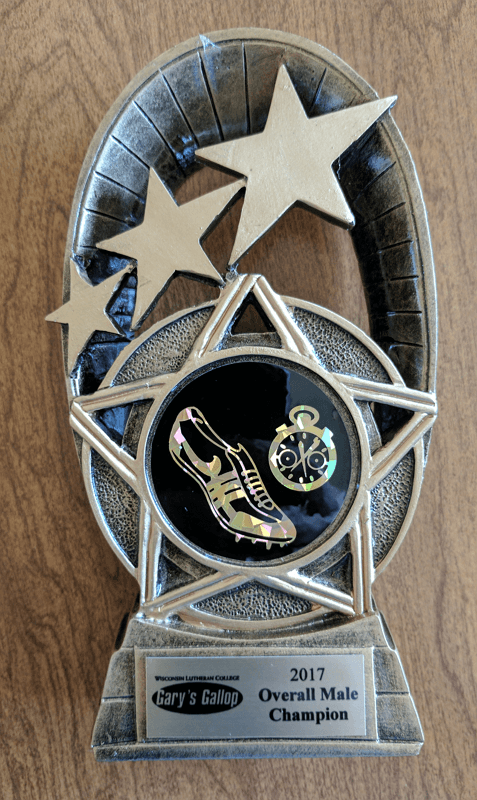
Plus they have some nice hardware:

Image

Showing up

This article was originally posted by Ryan at the original HillRunner.com Blogs.

Image

“It’s hard showing up day after day. It’s worth it but it’s hard.” – Jon Marcus

I was recently listening to the Magness and Marcus podcast and I heard that quote from Jon Marcus. I was already thinking of writing about this topic and that quote just clicked with me because it’s so true and so important to running.

I often find myself saying the biggest key to success in distance running is consistency. How do you be consistent? Well, obviously you have to stay healthy so your training isn’t sidelined by injury. However, in my opinion, the biggest factor is just showing up.

On those days your motivation is lagging but you know you have work to do, you get it done.

On those days when the weather sucks and you just want to stay inside, you get out the door.

On those days when the treadmill is the only good option and you hate treadmills, you get on it anyway.

It’s not easy to show up day after day, week after week, month after month. But being hard is part of what makes it so worthwhile. When you reach your goal that others were telling you was impossible, you know how you got there.

Which brings me to another quote, which seems to be commonly attributed to Jerry Rice. “Today I will do what other won’t, so tomorrow I can accomplish what others can’t.”

Photo credit: Loneliest by Andrew Murray, on Flickr

Sleep matters and building muscle

This article was originally posted by Ryan at the original HillRunner.com Blogs.

Sleep matters

How important is sleep? Really important.

In this study, cyclists were either allowed normal sleep (about 7.5 hours) or kept sleep deprived (about 4 hours) after a workout.

The result? Sleep deprived cyclists were sleepier (shocker!) and less motivated to train. In addition, their blood pressure had not recovered as much as those who were allowed normal sleep, suggesting less complete recovery from the workout.

These results shouldn’t be shocking but they are a good reminder.

Building muscle

I’ve been going back into the archives a bit recently and this one popped out at me. What does it take to build muscle?

In short, all those things we have usually thought of from weight to number of reps doesn’t matter as much as one thing: lifting to failure or near failure.

Your Acute-to-Chronic (A:C) training ratio

This article was originally posted by Ryan at the original HillRunner.com Blogs.

Image

By now, I’m sure most of you know my thoughts on the “10% rule”. It’s far too simplistic. That said, there is such a thing as building up too quickly, right?

Of course there is. It’s just not as simple as this week should always be no more than 10% more distance than last week.

Ideally, we listen to our bodies to know if problems are creeping up but what if we had cues to tell us when we may need to pay closer attention or take concerns more seriously?

Enter the Acute-to-Chronic training ratio (what I will abbreviate as the A:C ratio).

What is the A:C ratio?

It’s simply your past week’s running mileage divided by the average of your past 4 weeks. An example might be helpful.

Let’s say your past 4 weeks have looked like the following:

45 miles

50 miles

55 miles

60 miles

Your A:C ratio is then 60 / 52.5 (52.5 is the average of 45, 50, 55, 60). Rounded off, this is 1.14.

Research has found that, on average, injury risk climbs when you hit a ratio of 1.2 and significantly increases around 1.5.

However, that’s for the “average” person. How many of us are perfectly average? If you look at your history, you’ll probably find that there is some fuzzy area where you cross from being relatively solid with no real injury concerns to where you feel like you’re walking a tightrope.

With this knowledge, you could actually adjust to where you know that, for example, at 1.3 you begin feeling not so great and bad things happen when you get over 1.6. So you can watch for those numbers instead of 1.2 and 1.5.

Also, some suggestions are that you take intensity into account. Not all miles are equal. A 5 mile tempo run is more strenuous than 5 miles very easy. This is a little more complicated to keep track of but might make this kind of ratio even more useful as you can track increases in both volume and intensity.

Why is this better than the 10%rule?

To be honest, this is a similar concept to the 10% rule but, depending on how deep you go, it offers more flexibility.

First, in even its most simple sense, you are given two levels to watch: graduated risk and high risk. It’s not as simple as 9.5% = good, 10.5% = bad.

Second, I like the idea that it doesn’t just take a look at the past two weeks. By looking at the past 4 weeks, it gets a more complete picture of your recent training, not just a very limited snapshot. It would be great to look at 2-3 months, of course, but I get how that would complicate things. 4 weeks seems like a decent compromise.

Third, the idea and, in some circles, encouragement to adjust those numbers to your unique needs is outstanding. Track your history, find the numbers that work for you, then adjust.

Finally, if you go the most complex route and add in intensity, you’re measuring not just volume but total training stress. This is an outstanding, though admittedly much more complex, addition to the equation.

In the end, obviously, we aren’t robots. No numerical formula is going to perfectly predict injury risk. You might get injured when your A:C ratio is below 1 (meaning you’re reducing training load) or you might be able to stay healthy when it’s above 2. At 1.3, you might get injured one time but not another. However, if we can track when our risk is increasing, we can be more aware of that and take more precautions.

Addition to the training log

So what does all of this do for us if we’re not easily able to track it? That’s what I started asking myself and I realized I had the ability to offer a solution.

Starting this morning on the HillRunner.com Training Log, you can track your A:C training ratio. It’s right there on your sidebar, easy to see and updated in real time as you update your training log.

Currently, it’s the most simplistic solution. If your ratio is below 1.2, it will show up as green:

Image

From 1.2 to 1.5, it will be orange:

Image

1.5 and above, red:

Image

In the future, I plan to build out this functionality as follows:

First, I want this to be an optional sidebar widget, as are some of the others such as the weather widget, controllable through your log settings.

Second, I plan to make those thresholds customizable. They will default to 1.2 and 1.5 but you will be able to change them to the numbers that work best for you.

Finally, my most ambitious thought is to include intensity. This will take more work as the log doesn’t currently track intensity but I’d like to see it included in the long term future.

As far as I know, the HillRunner.com Training Log is the first log to include this A:C training ratio. As always, I am aiming to provide an easy to use, convenient, but useful training log. I hope this is an addition that, while not affecting ease of use, will conveniently add a useful tracking measure.

Photo credit: PSY_1987 by Inland Empire Running Club, on Flickr

Restraint

This article was originally posted by Ryan at the original HillRunner.com Blogs.

Image

Spring is on the way! While many of us already had some summer like weather this year, we’ve also faced some challenging winter weather. Things will be taking a turn soon if they haven’t already begun taking a turn where you are.

It’s so easy when the weather gets better in the spring to get a little too excited about training in good weather and try to do too much. Be careful not to fall into this trap.

After working your way through all the bad winter weather, the last thing you want to do is get yourself hurt when the weather is turning nice, especially since your racing season is likely also just around the corner.

Photo credit: DSCI0012 by Tory Klementsen, on Flickr

Scroll to Top