
Ryan

Recovery aids and racing shoes

This article was originally posted by Ryan at the original HillRunner.com Blogs.

Once again, some of the best things I’ve read this month have come from Alex Hutchinson’s excellent Sweat Science blog. The two I’ll share this month are one on Curcumin as a recovery aid and how the weight of your shoes affects your performance.

The Curcumin Cure for Muscle Soreness?

I used to take antioxidants nearly daily to aid in recovery. My belief, supported by the best knowledge at the time, was that enhanced recovery would allow me to train harder. That would allow me to get more training benefit. Then a number of studies came out showing that antioxidants actually affect the training benefit. So you recover faster to train harder but there is less benefit you’re getting from the training.

Every time we hear about a new recovery aid, it seems like the same dilemma comes up. The issue as we see it now is that the damage caused by workouts is actually what triggers our bodies to build back stronger, which is the whole point of working out to be more fit. If you take a recovery aid, you’re lessening that damage and, as a result, lessening the training benefit.

Well, here’s another recovery aid that leads to the same dilemma. Curcumin, an antioxidant and anti-inflammatory found in turmeric, is the latest.

In this case, scientists tested runners doing a demanding downhill run to inflict muscle damage. Typically, after one workout like this, our muscles adapt and a second one is much less painful. This is why it’s a good idea to include some downhill training before running a downhill race like the Boston Marathon. However, those who took curcumin after the first run were actually more sore after the second run a week later.

Once again, when looking to maximize the benefit of training, it seems like it’s best to stay away from the recovery aids. Save them for when you have a race coming in the near term future and your goal is to be as recovered as possible when you are stepping up to the start line.

How Much Do Heavy Shoes Slow You Down?

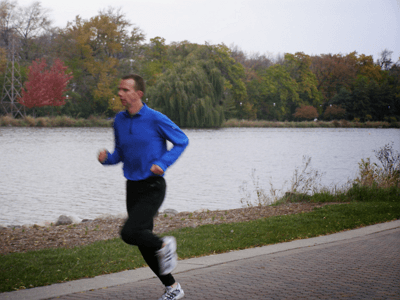
As many of us are in or soon will be heading into our fall racing seasons, this is a topic that may be on our minds. What should I wear on race day? How much of a difference does shoe weight really make?

Well, the answer is even a few ounces can make a difference. This has been theorized for some time. I recall in the 1990s talk of around 1% reduction in performance for a 3.5 ounce increase in shoe weight. However, this hasn’t been well tested until now.

It appears that the real world results are pretty close, coming in at roughly 0.8% per 3.5 ounces at 5:30 per mile and possibly higher amounts at slower paces.

There is one important catch, though. Cushioning increases efficiency. If you decrease your shoe weight too significantly, it’s very possible that you actually negatively affect your performances.

So where does that leave us? Largely, trial and error. Don’t be afraid to try lighter shoes but don’t jump right into the lightest you can find because that might not be as good as it may seem.

Deal with the little issues before they become big

This article was originally posted by Ryan at the original HillRunner.com Blogs.

Image

Have you ever found something not feeling quite right and ignored it? What was the result? Chances are you ended up injured not too long after.

Pay close attention to these things. It’s true that we can’t always cut back our training every time something is a little off or, especially as we age, we’d never be training at full capacity. However, we can and should at least pay attention to these things. We can be proactive immediately and, if they get progressively worse or don’t go away for an extended period of time, we can adjust our training before we’re forced to take time off.

Being proactive doesn’t have to mean rest. It can mean "prehab" as some people call it. A little extra stretching, some strength work to target weaknesses that may be the root cause of the problem, maybe a massage appointment. Whatever it takes, it’s better to do a little up front than to be forced into a long time off down the line.

If being proactive isn’t enough, then it’s time to make some hard decisions. Will reducing training load for a week or two help? Will taking a day or two off, even a week, now prevent a longer forced time off later? If so, isn’t doing that worth it?

I will definitely expand on this in the future. As for now, just a quick reminder to pay attention to the little things and deal with them before they become big problems.

Photo credit: Running painful ankle injury by 4Chion Marketing, on Flickr

Fitness first, details later

This article was originally posted by Ryan at the original HillRunner.com Blogs.

Image

I’ve recently been writing a lot of Seattle Marathon training plans and a common theme has been coming up, especially for beginning runners or those who have been out of running for a while. The most important first step isn’t some magic bullet, it’s building basic fitness.

A lot of these plans I’ve been writing haven’t been all that exciting. Some involve workouts only once every two weeks, if at all. Most involve fairly conservative volume progressions. The most elaborate aspect of these plans often is the fact that I’m asking the runner to consistently get a run in 3-4 times a week.

It might seem that the people paying for these plans aren’t getting what they are paying for. However, as I explain in the emails I’m sending them, they are getting just what they need.

When you’re new to running or you’re getting started after a layoff, you need a good foundation to start. There are no shortcuts. There is no magic bullet. There is simply basic work that needs to be done.

Once you build that foundation, you can do more extravagant things. Until that foundation is in place, though, those things are a greater risk than benefit.

So, if you’re new to running or newly returning, make sure you start with the basics. It may not be exciting but it’s the safest and best way to get to where you want to be.

Relax and let the speed come out

This article was originally posted by Ryan at the original HillRunner.com Blogs.

Image

He knows what he’s talking about

If you watched the US Olympic Trials coverage on NBC, you may have noticed Ato Boldon repeatedly say that the fastest sprinters would "relax and let the speed come out". I was hoping he would use that line again in the Olympics but I didn’t notice it the way I did at the Olympic Trials.

Why was I hoping for the repeat? Because that advice Boldon was offering to any sprinters who were watching is also great advice for distance runners.

What does advice on sprint mechanics have to do with distance running? A lot.

Boldon’s advice is universal. When you tense up, your opposing muscles are working against each other, requiring more energy to do the same amount of work.

A simple way to think about this is to think of the opposing muscles of the upper arm, the biceps and triceps. If you’re trying to bend your elbow to lift something, you need to flex your biceps muscle. However, what you don’t always think about is that you also relax your triceps muscle. If you don’t, your triceps muscle is pulling to straighten your elbow and working against your biceps.

What does this have to do with relaxing to let the speed come out?

When you’re tense, your muscles are contracting. When you’re relaxed, as the term suggests, your muscles are relaxed. Only the working muscles are contracting.

When you’re tense, your contracting muscles are fighting against each other. When you’re relaxed, only your working muscles are contracting to do the job. There are no opposing muscles contracting to work against your working muscles.

In short, when you relax, you’re not spending energy to work against yourself. You can save energy and deliver more power into the work you want to get done (like propelling your body forward).

So what do we do now that we recognize how important it is to relax in order to let the speed come out? Practice, practice, practice. I see a lot of runners, myself included although I’ve been working on it in recent years, who strain and get very tense when working hard. Whether in workouts or races, you can see the strain in their faces and, many times, throughout their bodies.

In training, try to focus on fighting the urge to tense up and strain. Work on staying loose when the going gets tough.

Photo credit: Ato Boldon by Dhanika Ranasinghe, on Flickr

Hootie Hustle – 5K

This article was originally posted by Ed at the original HillRunner.com Blogs.

The weather for race day seemed like it wouldn’t be very promising to set a PR. Ryan and I had discussed this and I decided that, like Ryan said, we don’t need to worry about time just place. I figured I would do my best to get and stay ahead of as many people as possible and then pass as many as I could while gutting it out to the end.

My wife Debby came out to support me and that was nice to have her drive (and be there for me) so I could refocus my race day nerves and anxiety. She has an amazing calming effect on me that I really appreciate. We pulled in right next to Coach Hill. It was raining lightly as I went to get my packet. I was thinking, last year it was rainy and cool and I PR’d then, so maybe . . .

I asked for my packet and got one of the biggest compliments ever. The lady running the event said she was waiting and waiting to see me register and was excited when she saw that I registered. REALY – me?! That was a little boost of confidence.

Got back to the car and the rain was picking up a bit. I pinned the bib on, relaxed a little bit more and asked Ryan if he was ready to warm-up. We headed out for a very easy paced warm-up of 1.32 miles at an 8:37 pace. We stretched a little and changed into Race Gear. Then like in Ryan’s race report we headed over to the bleachers under the press box for some final stretching and warm-up. We did some strides on the track and I was unusually calm.

We lined up at the starting line and when they counted down – we took off. I immediately found myself in very odd territory. I was just behind Ryan with no one else ahead of us – I was in second place. I checked my Garmin to be sure that I wasn’t blowing myself up to die in the end and I was out a bit quick with the 1st quarter mile in 1:24 or 5:36 per mile. I didn’t have to worry about slowing it down because Ryan did as did the two guys behind me. I got through mile one in 5:57 – I was hoping to be a bit quicker but this is good because I was conserving energy with the two guys not dropping off from us.

I contemplated trying to catch Ryan who wasn’t but a couple of seconds ahead of me to let him know that we needed pick it up or the two guys behind us might make a move and catch us but I decided against it. That was good because we had indeed picked it up a little bit finishing mile two in about a 5:53 pace. I was hurting a bit but knew that 1.128 miles should be easy and that was all I had left to go. I pushed on trying to slowly gap the guys behind me. I started looking behind me at turns to try and gauge how the two threats were doing. I saw that one of the guys had dropped off and now I had to fight to keep second as one guy was about three to four seconds behind me.

I knew that there was a good downhill portion coming up on which I could open up and hopefully put a bit more space on him. At this point I quit checking on him because I didn’t feel like I was going to fade. As I reflect a little, I wasn’t even thinking of getting second place just staying ahead of the guy behind me. I was in such a tunnel vision that I don’t recall even seeing Ryan just ahead of me. I was trying to listen to race volunteers that cheered for us as we passed to hear how close the guy behind was. But I couldn’t tell.

As I made the tight turn and headed onto the track I knew I had about a quarter mile to go – that is short no matter how much I am hurting at this point. The third mile (I didn’t know it at the time) was run in 5:36; my fastest mile ever. I pushed as hard as I could around that track unaware of anything other than the finish line and my inability to breathe anymore. I turned to go straight up the football field toward the 50 yard line ready to collapse. I saw the clock in the very low 18s and thought “this is a new PR!” I ran through the finish line and fell to the ground dizzy, light headed and gasping for air.

Ryan, being a good coach, wouldn’t let me lay on the ground. He helped me up and got me walking. We figured I came in somewhere just under 18:10 another PR and my highest ever finish – 2nd place!

I ended up running 18:06 which is 24 seconds faster than last year at this same event and a new PR by eight seconds! Very happy with these results –

http://media.wix.com/ugd/d60b0e_add9b592616f4573a3defc34c18f8ce7.pdf

Event page – https://www.honoursinc.com/!results-and-photos-2015/ybyri

Scroll to Top