Hill training and sleep

This article was originally posted by Ryan at the original HillRunner.com Blogs.

A couple things that greatly interested me popped up over the weekend. Here are some quick thoughts on them:

Hill training

We hear all the time about the benefits of hill training. While there are reasons going beyond hill training for it, the name of this site should tell you something about what I think of it. It just works. Runners and coaches around the world know this.

This is a case where the coaches and runners are ahead of the science, though. How many studies have we seen that show hill training works and why? Well, now we have this:

Running on a 10 percent incline can improve the overall performance of long distance runners, according to a study completed by Derek Ferley, education and research coordinator at Avera Sports Institution. He conducted the research as part of his doctoral work in health and nutritional sciences at South Dakota State University.

I have some problems with this. First, the workouts don’t appear to be apples to apples. The hill repeats group was doing 30 second repeats and the flat intervals group was doing repeats of 2:16 in duration. Second, it was all or nothing. The three groups consisted of no workouts, twice a week hill workouts and twice a week flat interval workouts. I’d love to see a fourth group that did hills once a week and flat intervals once a week. Finally, as pointed out, the fitness test at the end was performed on a level grade. If you’re training to race on a track, this may hold meaning. Anywhere else, we’re not likely 100% level in nearly any race.

So it’s the beginning of some answers to the questions that could be asked but I see some flaws in this that warrant further study. I also see the ability for nearly anyone with a motive to twist this to say something they like.

Sleep

I’m a big proponent of sleep. There are numerous studies that show the benefits of more sleep, even up to 10 hours a night, have real benefits for athletic performance, recovering from workouts and various other factors that matter to athletes. However, I’ve always wondered whether we should be able to expect to sleep straight through the night or whether that kind of sleep is really beneficial for everyone. I don’t remember the last time I’ve slept through the night without waking at some point, at least for a short period of time. I know others who simply can’t or won’t sleep for more than 4 or 6 hours a night. Are we hopeless cases who will never fulfill our potential?

Maybe not:

Our modern society, with its many stimuli, and an environment full of light, has partially created this hysteria about sleep, and combined with the myth that an 8-hour block of continuous sleep is essential, does all of us a disservice. Don’t forget about the well-documented benefits of incorporating naps into your day.

I have no doubt that 8 or even more hours is beneficial for many people, especially athletes who are pushing physical limits and need plenty of recovery. However, there are exceptions and we could be doing more harm than good stressing over sleep if we are the exceptions.

Also, naps are good.

When will we see a 1:59 marathon?

This article was originally posted by Ryan at the original HillRunner.com Blogs.

Image

I wrote a little about this Sunday when posting about Dennis Kimetto taking the marathon world record under 2:03 but I don’t think I’ve written a full length post on this so here it is.

Every time the record is broken and, especially, when a "minute barrier" is broken like we saw on Sunday, the discussion always starts: how soon until we see someone run a marathon in under two hours? It seems like, every time we go through a new "minute barrier", we get predictions that breaking through the two hour barrier is imminent. It’s only a matter of 5-10 years. I’ve been hearing that it’s only a matter of 5-10 years for over 10 years now and I wouldn’t be surprised to hear the talk has been going on even longer.

The fact that "within 10 years" has been going around for over 10 years should say something about how likely these predictions are. However, let’s look at the factors involved. I’d like to look at things by the numbers and consider recent trends in distance running and what they might mean for the future.

The Numbers

First, the progression of the world record. Let’s consider how long it took for each "minute barrier" to be broken:

2:08: 1985

2:07: 1988 (3 years)

2:06: 1999 (11 years)

2:05: 2003 (4 years)

2:04: 2008 (5 years)

2:03: 2014 (6 years)

I started with the 2:08 barrier because there’s debate about when the 2:09 barrier was broken. It was either 1969 by Derek Clayton (this is a disputed record, due to a course that was possibly 500 meters short) or 1981 by Rob De Castella.

There are a few ways we could look at this:

Fastest case scenario: The progression from breaking the 2:03 barrier to breaking the 2:00 barrier follows the progression from 2:08 to 2:07. That means 3 years per minute or 9 years from now we’d see a sub-2:00.

Slowest case scenario: The progression from breaking the 2:03 barrier to breaking the 2:00 barrier follows the progression from 2:07 to 2:06. That means 11 years per minute or 33 years from now we’d see a sub-2:00.

Middle ground: The progression from breaking the 2:03 barrier to breaking the 2:00 barrier follows the average progression from 2:08 to 2:03. That’s 5.8 years per minute or roughly 17-18 years total for 3 minutes.

One thing to notice about the above trend: Notice how the 2:06 barrier took 11 years to break? The 1980s was a golden era of marathoning. One could argue it only took 4 years to break the 2:08 barrier, then 3 years to break the 2:07 barrier. Then it took 11 years to see the 2:06 barrier broken. This is the reversion to the mean we would expect to see. I wouldn’t be shocked if, after seeing "minute barriers" broken fairly regularly recently, we are heading toward another dry spell relatively soon. Even if not, don’t expect that 4-6 years per minute improvement to accelerate.

So the progression so far suggests, in my opinion, that we’re looking at another 17-18 years, give or take, before we see a 1:59 marathon. What other considerations should be taken?

Recent Trends

I mentioned that the 1980s was a golden era of marathoning. If that was a golden era, then this is a platinum era or something along that line. Why?

Money

The top rung of the marathon ladder right now is awash in money. Between huge appearance fees, generous prize money, time incentives and additional prize money from the World Marathon Majors, the best of the best marathoners can make a lot of money. More than that, though, money in distance running on the track is drying up. In fact, the 10,000 itself – the event we’d expect to be the closest crossover to the marathon – is a dying event on the track. It’s very infrequently run outside of championship meets and not a big money event. Not surprisingly, we’ve seen times stagnate or even regress in that event. The world record in that event will turn 10 years old next year and nobody is challenging that record. By world class running standards, nobody is even close. That’s at least partly because all the talent that used to be running the 10,000 is moving up to the more lucrative event.

As all the best talent moved up to the marathon, skipping the track or at least spending much less time on it, we see runners at their prime trying the marathon. In the past, the usual trend was to run track through your prime, then move up to the marathon. This was surely the path followed by Paul Tergat and Haile Gebrselassie. Since Geb, though, we have Patrick Makau, Wilson Kipsang and Dennis Kimetto breaking the record. These are not big name track guys moving up to the marathon. They are marathon specialists.

This money in the marathon and the resultant marathon specialist running the marathon in his prime is a historical shift within the sport. It’s a one time event that will produce a surge in improvement over the short term but will not drive continual progression. Eventually, the progression will slow. I wouldn’t be shocked to see the 2:02 barrier broken within the next decade but then things are going to move a little more slowly unless or until we encounter another historical shift.

Approach

The late Samuel Wanjiru was a fearless runner. He’d attack from nearly the very beginning of a marathon and would not relent until he crossed the finish line. He is often credited with changing the philosophy of the top marathoner. Instead of a marathon being a 20 mile warmup followed by a 10K race, it became a race from gun to tape.

This racing philosophy and the corresponding training philosophy is mentioned by the great Renato Canova in his review of the record.

This approach surely played a role as guys are more willing now to lay it all on the line early. Sure, it results in some epic disasters at times but it also results in guys coming closer to their ultimate potential.

Again, though, this is a one time occurrence. As guys refine this approach in order to walk the line of epic disaster without going over, they will continue to incrementally improve but the big gains from changing the approach to racing a marathon have already been accomplished.

Doping

It would be remiss of me to ignore another point that was brought up to me after I made my comments about this on Sunday. I was reminded that this golden age of marathoning doesn’t just coincide with more money in the marathon. It also coincides with more stringent doping controls in track and field. Is it likely that the drug cheats are moving to the less stringent marathons? Absolutely. However, in the same way that I describe money creating a relatively short term spike in improvements above, the drug situation would do the same thing. The difference would be that, if marathons follow track and field some time in the future, we’d actually see a regression in performances. That would mean expect to wait even longer.

Note: I’m not accusing Kimetto or anyone else individually of doping. I don’t believe in saying "he’s so fast he must be doping". I believe you better have some kind of solid evidence before making such severe accusations. However, it would be naive to think nobody is. It’s possible that dopers are raising the depth of the field and that’s requiring honest athletes to push that much harder to rise above the pack.

Conclusion

This is truly a golden age of marathoning. We’re seeing amazing times at almost every race that could not have been imagined even a decade ago. If you like insanely fast times, I hope you’re enjoying this. Just don’t expect it to continue at this rate indefinitely and definitely don’t expect it to accelerate. That means don’t expect a 1:59 marathon in the next decade. Maybe in the next 20 years but I’m not even convinced we’ll see it in that amount of time.

Strength training for injury prevention/treatment

This article was originally posted by Ryan at the original HillRunner.com Blogs.

Image

I’ve been quiet on my recent Monday and Thursday blog posts recently. Let’s call it a late summer break so we could all enjoy some free time. Here’s a short one to begin getting back on schedule.

Anyone who has received my advice or been closely following my blogging recently knows that I’m a big fan of treating and preventing injuries using a multi-faceted approach. Specifically, I think both strength training and flexibility/mobility training need to be considered. It used to be that everything was about flexibility. Get your soft tissues loose so they can pass through a full range of motion and they won’t be so tender. That makes total sense but here’s another thought: make your soft tissues stronger and they will be less susceptible to breaking down. Make sense?

It works for the IT band.

It works for PF.

Dennis Kimetto: 2:02:57

This article was originally posted by Ryan at the original HillRunner.com Blogs.

Image

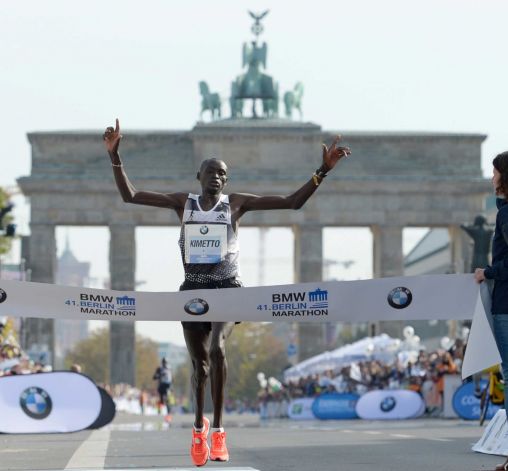
For those of you who haven’t heard, Dennis Kimetto this morning shattered the marathon world record in Berlin with a 2:02:57. That takes 26 seconds off the former world record, held by Wilson Kipsang. With his customary second place finish (his sixth time finishing second at a major marathon) Emmanuel Mutai also went under the former world record.

I see three things with this world record.

First, what an amazing run. Notably, Kimetto had Mutai to run with until he broke away with about 2.5 miles to go based on reports I’ve seen. In fact, Mutai was the one pushing the pace for a while. Even when Kimetto broke Mutai, he had to push the whole way because Mutai didn’t just disappear. Direct competition in a fast race like this can do one of two things. Sometimes, it causes the pace to slow as runners size each other up and play the tactical game. Other times, someone decides to just lay it on the line and go all out. In this case, obviously, the latter happened.

Second, let the Boston 2011 "record" be laid to rest. Geoffrey Mutai’s 2:03:02 can be retired as the fastest time anyone has ever run but not the world record. Good riddance. I never liked that discussion. There’s a reason standards need to be met in order for a course to be record eligible and the insane tailwind of 2011 proved why those standards matter.

Third, let the sub-2 hour talk heat up. The safe money is still on it being a long time before we see a sub-2 marathon but that won’t stop some people from talking about it as if it will be in the next year or two.

Just a quick recap of why it will be a long time: The sport has undergone a drastic change in the last decade. There used to be big money in track and field and less money in the marathon. That balance has shifted. Between big appearance fees, big prize money including time incentives encouraging faster times and the World Marathon Majors prize structure, we see the marathon becoming a very lucrative pursuit. In the meantime, the 10,000 on the track has all but died. That’s drawing the best of the best to the marathon and encouraging them to chase what just a decade ago would have seemed like insanely fast times. The result is a historical shift in the talent pool resulting in a relatively short term dramatic improvement in performances. The 10,000 meter world record on the track will turn 10 years old in 11 months and hasn’t been seriously threatened in some time. That’s because potential world record holders in that event are skipping it in favor of the marathon. In the meantime, Kenenisa Bekele who holds that world record is moving up to the marathon and will likely do well at the upcoming Chicago Marathon but won’t set the world on fire with the world’s second 2:02 because he’s past his prime.

So don’t expect a sub-2 hour marathon in the next few years but enjoy this amazing time in marathoning and understand that it’s truly a historical period for the marathon. It will take at least one more historical shift like this, though, before we can expect the 2 hour barrier to fall.

Finally, congratulations to Kimetto on becoming the first person in history to run a marathon under 2:03. What an amazing performance.

Race report: 1st annual Hootie Hustle 5K

This article was originally posted by Ryan at the original HillRunner.com Blogs.

I’m always nervous about inaugural events but this is a fundraiser for the scholarship program at my daughter’s school district. She will possibly benefit from this program in the future so I kind of felt obliged to make a showing.

Of course, any time I toe the line at a 5K, I’m thinking about breaking 17 minutes. Given that this was an inaugural event and that this is in a town where "flat" is a relative term, though, I was a bit skeptical. As it turned out, the course was about as flat as you can make it here but that’s not necessarily saying much.

The course started at the high school, at the gated entry to the track and football field. It then hit town roads, went up a long, gradual incline to the middle school, then looped back around to the high school, finishing with about 3/4 of a lap on the track and a U-turn into a 50 yard line finish on the football field.

I warmed up over the last 3/4 mile of the road portion of the course. I was feeling good but not great. Still, I expected to at least be in contention for the win and I expected myself to at least be in the low 17s.

At the start, I ran what I was told was the route and a few others seemed to be cutting some turns a bit short. Not a big deal but one of those guys was pretty persistent. Right on my shoulder the whole time. This was not going to be one of those inaugural events where you show up and win by 3 minutes. I had some formidable competition on my hands. That’s fine. There’s a time and place for time trial-style races but I’m always a fan of good, head to head competition.

We made a few turns then, probably before the half mile, started the long climb that would take up more than the next half mile. By this point, the guy who had been running behind me had already challenged me once or twice. At this point, between the coming long climb and a head to head battle, I knew this race wasn’t going to be a gun to tape time trial. I know I’m fit enough right now to run a real nice time but I’m not in the kind of race where I can just throw caution to the wind and go for it. The course is going to suck some life out of my legs and I don’t want to hammer the second mile and risk blowing up and getting passed in the last mile. So I hang tight up the hill, let this guy pass me a couple times but come back on him each time. Finally, as we reach near the top, he pulls away from me just a bit. I tell myself let him go and there’s a gradual decline where I can bring him back in as he’s sucking air from the effort on the incline.

I think it was on that decline where I saw the 2K mark. About 200 yards earlier, I was telling myself we had to be past the mile even though I saw no sign of it. It was a relief to know I was right. At the same time, I was back in the lead and I told myself the next 2K is make or break time for me. So I pushed but did so with just a touch of caution. Again, I wanted to make sure I had something left for the finish just in case. I knew I was pulling away a little but not much. Around a turn, not too far from what I estimated to be about a mile to go, and I see the 3K mark. OK, still on track and I’ve built up a bit of a lead. I round another turn and start the downhill stretch. By this time, my legs are worn down enough that I couldn’t really attack the downhill the way I wanted but I do think I opened up more of a gap there. Down at the bottom, I tried opening it up a little. I had some energy yet but my top speed just didn’t seem to be there.

I came into sight of the track with the clock on the scoreboard just over 15 minutes. I figured I had about 2 minutes to go but I figured I’d miss sub-17. I didn’t want to hammer until I was on the track so I picked it up a bit and got myself to the track. We do a near U-turn to enter the athletic fields and I see my lead is comfortable but not huge. I push a little harder but just don’t have that last gear. On to the track, I keep pushing and I watch the clock. Ticking toward 16:20. I figure I have about 200 meters or a little more to go as the clock hits 16:20. Can I run a 35 second 200? I doubt it but I try. Again, no last gear. I think the hill just took that speed out of my legs. I make the couple sharp turns to enter the football field and head toward the finish line. As I take the last turn, I see the clock ticking toward 17 flat. It isn’t happening. I have the win comfortably but I’m not going to kill myself for another second or so here.

I end up finishing in 17:05. Second was an assistant coach for the high school cross country team. A very good runner himself and obviously someone who knows a thing or two about running. Third was a young guy, probably not in high school, a few minutes back. He has a lot of potential.

All said, this was a very good race. Just not one you go to looking for a fast time. They have a few kinks they could work out but very solid for an inaugural effort. They also had very nice and unique awards for the top 3 overall finishers. I give them credit for standing out with their awards and for holding a quality event in their first attempt. I definitely think this can grow into a very nice race.

As for me, I feel good with this. Yes, I just missed sub-17 for the second time this year but I know, given a few sharp turns on the course and the long climb that drained my legs, I’m ready for it on the much faster course I’ll be at in 3 weeks.

Scroll to Top