
Training

All things training. Mostly advice and tips but maybe questions, general comments, or who knows what else.

Going to the track? Ignore the GPS

This article was originally posted by Ryan at the original HillRunner.com Blogs.
Image

It doesn’t take much to create very poor measurements on a track

Last week, one of the runners I coach decided to take her workout to a track. Personally, I think this was a good idea as there are advantages to the track that she could benefit from. However, she decided to still keep track of her pace using her Garmin. With her permission, I’d like to share some of her experience because I think she got caught in a worst case scenario of what can go wrong with GPS devices at the track.

In short, she was doing a 2×2 mile workout. She knew to run 8 laps for 2 miles* but, in her first 8 lap repeat, Garmin recorded her as only running 1.76 miles. On the second, I believe she forgot to hit the lap button at the end of her 8 laps and she actually ended up running roughly 9.25 laps before her Garmin registered her going 2 miles. As a result, when she checked her Garmin to see the pace she was running, it was reporting her running about 30 seconds per mile slower than her target pace. Even though she was in fact running about 30 seconds per mile faster than her target pace. She finished the workout very frustrated until I looked at her Garmin tracks and recognized what was going on.

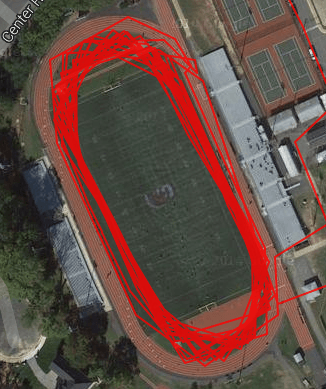
So what happened? How were her distances and paces off by so much? Well, the picture at the top of this post tells most of the story. Garmin recorded her route as being inside the actual track the whole way around. Below are a few close-ups that demonstrate what went wrong.

Again, I think this is a worst case scenario of what can happen but I think it serves as a good warning of what you can experience while running on the track. So, here’s what went wrong:

A little off adds up to a lot:
Image

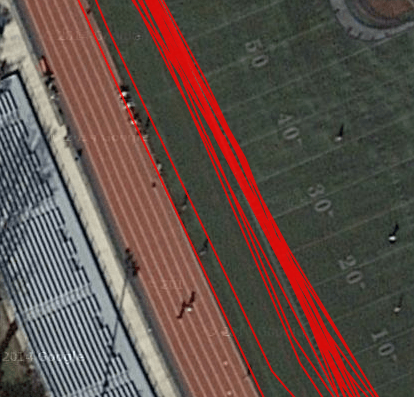
Garmin was "a little" off. Over 8 laps, a little each lap can add up to a lot.

The first problem was what was happening on the straights. As you can see in the above picture, Garmin tracked her as running down the straight on the inside of the track. This may not seem like a big deal. It’s not when you’re running down a straight road or trail. Whether it tracks you right where you are, 5 feet to the right or 5 feet to the left doesn’t really make a big deal. On the track, though, if it’s tracking you consistently 5-10 feet (or more) inside the track, that adds up when you’re running multiple laps.
Image

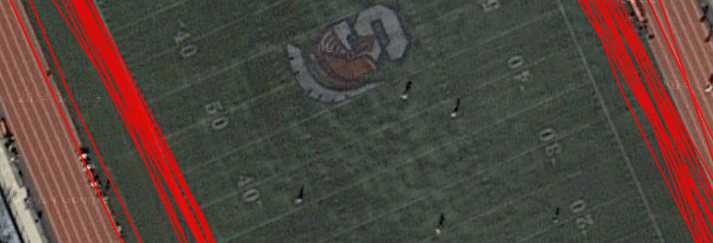
Worse yet, Garmin recorded her inside the track on both sides

This might not be a problem if Garmin consistently tracks you 5 feet off to the same direction. That’s not what she was experiencing, though, as you can see in the image above. Garmin was consistently tracking her on the inside – on both sides of the track. That’s where you get inaccurate distances from.

Cutting corners
Image

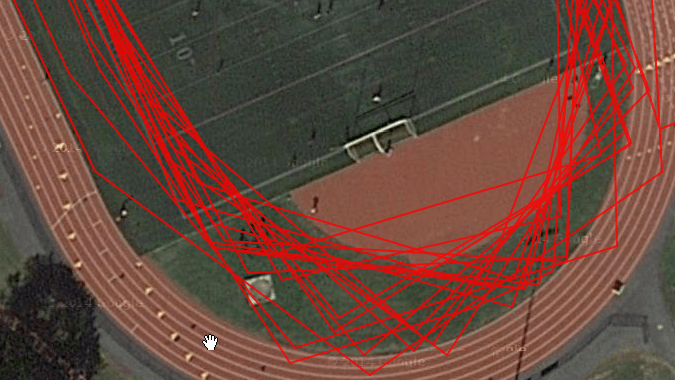
Nobody in their right mind would run like that!

The other big problem with GPS devices on the track is what you see happening above on the turns. GPS devices aren’t constantly tracking you every millisecond. They record your location once every several seconds and "connect the dots" to estimate the route you actually took. Again, this isn’t a problem when you’re running straight ahead on a road or trail as we do most of the time. It’s a big problem when you’re spending half of the time turning.

As you can see, Garmin assumed that she took perfectly straight lines between the points it recorded her location at. In this case, it meant Garmin recorded her running well into the infield, significantly shortening her route over 8 turns per mile.

These two factors combined resulted in Garmin roughly turning her 8 lap repeats into the distance of an actual 7 laps and greatly messing up her reported pace and distance. This is an extreme example of what can happen but I’ve seen this happen with other runners.

What to do?

So how do we avoid these inaccuracies? Well, you don’t have to avoid the track. There are some good reasons for hitting the track. However, you have to understand that tracks and GPS devices don’t get along well together. Instead, just use the stopwatch. If you want to check your pace, know what lap splits you’re going to be looking for and you can check every 1/4 mile if desired.

* Note: Yes, I know 4 laps on a track isn’t exactly 1 mile. It’s roughly 9 meters short of being an actual mile. 9 meters, though, is less than 3 seconds at 7 minutes per mile. Unless you have some need to be extremely precise, it’s close enough to serve the purpose.
Measure what matters

This article was originally posted by Ryan at the original HillRunner.com Blogs.

Image

How useful are lab tests?

Would you believe that I, a competitive runner of 25 years, have never taken a VO2max or lactate threshold test?

It seems like everyone has taken one or both of these tests. I’ve been asked what my test results are and people are shocked when I say I haven’t taken them.

The question I’d like to ask, though, is what we get out of these tests. What do they tell you that will help you become a better runner? We now know that training right at VO2max and lactate threshold isn’t necessary. In fact, it’s better to train at a range of paces around but not necessarily directly at those paces.

For example, with lactate threshold, we now know that, by training below lactate threshold, we can improve our ability to produce less lactate while running at relatively high intensities. By training slightly above, we improve our ability to clear lactate from the bloodstream by reusing it as an energy source or shunting it to other muscles so they can use it as an energy source. These benefits are stronger when you’re not right at lactate threshold than when you are.

But don’t you need to know your lactate threshold pace in order to know what paces to train at in order to be above or below? Here’s the cool thing. You don’t have to be precise. It’s actually not a bad thing to feel your way into these paces. It’s not the end of the world if you’re a little off. There is leeway built into this.

Besides, if you train at race efforts which I’m a big fan of, you’ll get the physiological benefits of the workouts, plus you’ll be getting practice feeling race pace. That makes you better able to feel your way into the right race pace on race day instead of relying on external measures. I’ve covered the benefits of running by feel instead of relying on external measures previously.

So what should we be measuring instead? Performance measures. How fast are you running your races? Are your workouts getting faster (or easier) from month to month? These are the things that are going to tell you how your running is progressing. A VO2max or lactate threshold test, while it may be fun to know the numbers, doesn’t produce a lot in regards to actionable information.

Note: This was inspired by a post written by Steve Magness at his great blog. I thought it was a topic very much worth bringing up here.

Low carb, high fat (LCHF) diets and the runner

This article was originally posted by Ryan at the original HillRunner.com Blogs.

Image

A little over a year ago, a coworker asked me for some advice. He was struggling with his long runs in preparation for the Boston marathon. We talked through things and all seemed fine. Then he mentioned that he had been trying the Paleo diet. While he had lost weight and was handling shorter runs at relatively low intensity well, he just couldn’t sustain for his long runs.

Low carb, high fat (LCHF) is the latest trend in the diet world. Interestingly, it has not just your typical snake oil salesmen pushing it but it has some high profile names, most notably Tim Noakes (of Lore of Running* fame) promoting it. I greatly respect Noakes but, in this case, I couldn’t disagree more.

The idea behind LCHF is that it’s the way our ancient ancestors ate. This is very likely true. Study evolutionary biology and it’s pretty clear that one of the key points of differentiation between our ancient ancestors and other primates was our diet. We hunted animals and ate meat and fatty tissue, not just roughage. However, research suggests that these early ancestors also foraged. They had a balanced diet of both meat and plant-based foods.

Further, modern distance runners competing in events of the marathon distance or shorter aren’t persistence hunters. Persistence hunters would run/walk long durations at relatively slow paces to keep animals moving, with only occasional surges at faster paces. They weren’t running at a maximal pace for relatively short periods of time. They were running at paces that would allow them to use fat efficiently.

As competitive distance runners, on the other hand, even if we train our bodies to burn fat as quickly as possible, we’re not going to be able to sustain 5K pace or even marathon pace. We need glycogen stores to accomplish that. We’re different athletes performing different tasks.

There may be an argument for ultra runners to go LCHF but, for those of us who are running distances of marathon or less, the evidence suggests we’re better off eating quality carbs.

An important note here, though is the word quality. I’m not telling you to eat highly processed foods and drink sugary drinks. Go with the quality carbs. Fruits and vegetables, starchy natural foods, whole grains. Those should be your primary fuel sources. The truth is that these LCHF diets do have some basis in the fact that we do eat a lot of junk carbs and getting those out, in favor of quality calories of any kind but including quality carbs, would benefit all of us.

As for my coworker, I encouraged him to eat more carbs at least in the day or so before his long runs to fuel those efforts. He did so and his long runs got much better. He ran well at the Boston Marathon and, while still limiting his carb intake, seems to be finding a better overall balance.

*Note: In the interest of full disclosure, the link to the book Lore of Running is no longer an Amazon affiliate link, it is now an Amazon Smile link. If you use that link to buy the book, a small portion of the sale will go toward the charity of your choice.

Photo credit: phil.lees, on Flickr

The secret sauce

This article was originally posted by Ryan at the original HillRunner.com Blogs.

Image

I bet Deena knows this "trick"

It seems like everyone is looking for it. What’s that magical workout that will make you PR at your next race or beat that big rival who you just can’t get ahead of? What’s that one workout that all successful runners do? What’s this or that coach’s or athlete’s go to workout?

I’ll tell you my secret sauce. It’s not mile repeats or progression runs or long runs. It’s not something we do every week for three months. In fact, ask the runners I coach and they will tell you that I don’t even like doing the same workout two weeks in a row.

There’s a reason I don’t like doing the same workout even two weeks in a row. Too many runners see the same workout they just did on the schedule again and they get competitive with themselves. If I did my mile repeats last week in 7:10, I should be better now so I should do them in 7:05 this time. Next week? 7:00. Then I’m under 7:00!

That’s not the secret sauce. That’s a recipe for disaster.

So what is the secret sauce? Simple: consistency. That’s it. If you get out there and follow the plan week after week, month after month, year after year, you’re going to see good things happen. Not every workout will go perfectly and some workouts may even be missed but that doesn’t matter because the key isn’t in any single workout. It’s in doing the workouts, long runs and easy days that are on the plan according to plan the large majority of the time. If you consistently get the plan done with only the occasional misses here and there, you’ll see results.

Yes, it’s true that some planning needs to be made. You need to do the right workouts at the right time. You need to make sure you cover your bases. You need to prioritize the right kinds of workouts. However, those are the details. The big picture is that you need to be doing the work day after day, week after week, month after month. That’s the true secret sauce.

What shoes do you wear while not running?

This article was originally posted by Ryan at the original HillRunner.com Blogs.

Image

I’m currently reading the book Tread Lightly*. In it, the authors mention the role the shoes you wear while not running play in your foot health and I’d like to bring this point up here because I think runners often overlook this point.

We runners are shoe geeks. At least many of us are. We can tell you all about the structural details of the shoes we have and probably even many shoes we don’t have. We think about what these mean to the health of our feet and legs. We rightfully treat the topic as a big deal.

But how much do we think about the structure of the shoes we wear during the rest of the day? We think about fashion. What looks good, what’s going to impress people, what will make us look better. How much time do we spend thinking about how these shoes will affect the health of our feet and legs? Shouldn’t we be thinking about this more?

It’s been well established that shoes with a pointed toe change the structure of our feet. Wear these shoes enough and our feet begin taking the shape of the shoes. Our toes no longer splay out as they naturally do. They get pinched in to a point usually around the second toe. Bunions are the biggest concern when this happens but we can also have issues including but hardly limited to numbness and pain caused by nerves being pinched between bones that are unnaturally positioned. It’s also not hard to imagine that, more generally, the function of our feet is compromised.

It’s also been established that shoes with raised heels give us issues. Women’s high heeled shoes are the most visible culprits but many work boots and men’s dress shoes also have raised heels. These shoes do a few things. First, they push our toes into the front of the shoes, creating many of the same issues we see in shoes with pointed toes. Add pointed toes to raised heels and you’re getting a double whammy. In addition, it’s been found that wearing shoes with raised heels over the long term shortens your calf muscles and Achilles tendons and makes the Achilles tendons more stiff. It’s not hard to see where this leads to problems with injuries in the muscles of the calf, Achilles tendon injuries, even foot problems like Plantar fasciitis.

You’re likely spending at least 8 hours a day in these shoes. Yes, our running shoes are important but we’re probably only spending around an hour a day in those shoes. The shoes you wear while not running greatly affect the health of your feet and legs if for no other reason than you’re spending a lot of time in them.

I know. I’m a guy. I don’t get the pressure placed on women to wear fashionable high heeled shoes. I also don’t work in a setting where I need to wear fancy dress shoes or work boots with raised heels. It’s easy for me to say think about the structure of the shoes you’re wearing while not running. I get it. However, consider what you can do. Can you go a little lower with the heels? Can you get shoes with more room in the toe? If you can, your feet, legs and running will thank you.

*Note: In the interest of full disclosure, the link to the book Tread Lightly is an Amazon affiliate link. If you use that link to buy the book, a small portion of the sale will help pay the bills at HillRunner.com. As always, use the link if you wish and thank you for the support.

Scroll to Top