Ryan

Club HillRunner.com open for early sign-up!

This article was originally posted by Ryan at the original HillRunner.com Blogs.

Image

Have you been looking for more at HillRunner.com? Have you been looking for a way to support HillRunner.com without signing up for coaching?

I’ve been hearing just these things from some of you. You’d like to see videos, you’d like more tips, you’d like a closer, more tightly knit community. Some of you have even been generous enough to say you’d like to support HillRunner.com financially but you don’t feel the need to sign up for coaching. That’s why I’m starting Club HillRunner.com. To meet all of those requests.

So what is Club HillRunner.com? To be honest, I picture the club as the community of runners who sign up. However, let’s talk about what this community can expect to see.

What can Club HillRunner.com members expect to get?

To start out, there will be three primary benefits of joining Club HillRunner.com:

1) Membership in a private Facebook group: This is a group where I will share weekly tips that I don’t share publicly elsewhere. I also share links to interesting articles when I have too many to blog about and I hope to see it grow into a community where we can share in our experiences, support each other and ask and answer questions in a more private setting than we can elsewhere.

Image

Every week, you will find a tip that is posted just to the group. From training tips…

Image

…to advice on form and everything in between.

2) Exclusive access to a library of training videos: The library isn’t yet set up but will be before Club HillRunner.com officially launches on July 1st. This will be a place to find short instructional videos on a variety of things, from strength training exercises to form drills, stretches and tips on running form. I’m sure it will also include a few other things of interest as the library grows.

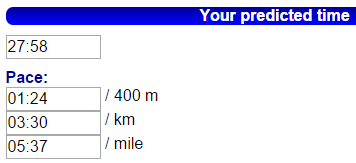
3) The HillRunner.com SuperCalc: Have you ever used the HillRunner.com calculators and found yourself wishing the functions of two or more could be combined into one? I know I have so I did something about it. I created the SuperCalc, which does just that. Simply enter a recent race result and you can get information on equivalent race performances, suggested training paces and more all in one place. Even some things that aren’t available in the currently available calculators.

Image

The SuperCalc combines the best of the HillRunner.com Calculators into one easy to use tool. It can predict your performance at any distance you would like, given a result at another distance.

Image

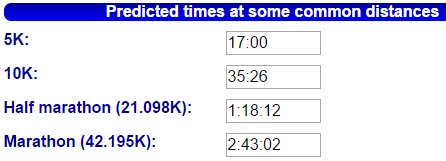
At the same time, it will give you equivalent performances at some commonly run distances.

Image

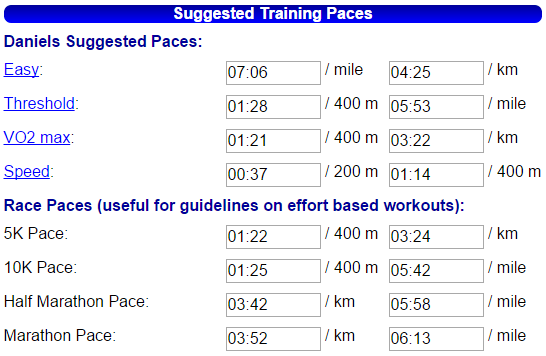
It will even help you find recommended training paces in the same place.

Keep in mind that more benefits will be coming in the future. For instance, I have some ideas to improve the training log that will be made available first to Club HillRunner.com members before they are made available publicly.

Finally, you’ll be supporting HillRunner.com financially. Some of you have asked about donating to the site. I appreciate the offers but I’ve never felt right accepting donations without offering something in return. So this is what I can offer. If you want to support HillRunner.com, this is how you can do so and get something in return.

Signing up is easy and inexpensive, especially if you do so soon! Right now if you sign up, you can get membership good through the end of June 2016 for just $10. Just follow this link to find sign up information.

Note: If you are receiving coaching from me, you are already a Club HillRunner.com member. No need to sign up!

If you have any questions about this new offering, please don’t hesitate to ask.

Beet juice for the brain, pre-exercise dynamic stretching

This article was originally posted by Ryan at the original HillRunner.com Blogs.

Beet juice for the brain

You’re late in a race. Maybe you’re running a 10 miler, shooting for 80 minutes, and you just went through 9 miles in 1:11:34 after going through mile 8 in 1:03:42. Quick. How much time do you have to cover the last mile and is that faster or slower than you covered the prior mile? Right now, that’s easy to answer. You know as well as me that it would be a far different story if you were trying to do the math during the race.

I’m sure we’ve all heard about the likely endurance benefits of beet juice and its key ingredient, nitrate (also found in dark leafy greens and some other foods). What if there were another benefit?

Well, Alex Hutchinson finds a study that points to another potential benefit.

When you’re exercising hard and hyperventilating, levels of carbon dioxide in your blood drop, which can in turn cause your blood vessels to constrict, reducing the amount of oxygen reaching your brain. The nitrate in beet juice, which is converted to nitric oxide, plays a crucial role in dilating blood vessels, so it may counteract this effect.

That’s just a hypothesis right now. However, with those taking beet juice able to respond to a cognitive test more rapidly, there definitely appears to be some benefit.

Pre-exercise dynamic stretching

What do you do in regards to stretching or mobility exercises before workouts or races? Nothing? Static stretching? Dynamic stretching? There is plenty of debate as to what kind of exercises are good to do pre-exercise or whether it’s best to do none.

In the battle of none vs. dynamic, let this be a vote in favor of dynamic:

The results demonstrated that the DS [dynamic stretching] treatment improved the endurance performance of running at a velocity equivalent to 90% VO2max in well-trained male runners, although it did not change the RE [running economy]. This running velocity is equivalent to that for a 3000 or 5000 meter race. Our finding suggests that performing DS during warm-up before a race is effective for improving performance.

This is when compared to non-stretching. I’d definitely consider this pretty significant. Time to exhaustion at 90% VO2max was significantly longer on average and total running distance was, on average, nearly 700 meters longer (just over 4301 meters vs. just short of 3617 meters). That’s a result to pay attention to.

Another honor for Coach Conway

This article was originally posted by Ryan at the original HillRunner.com Blogs.

Image

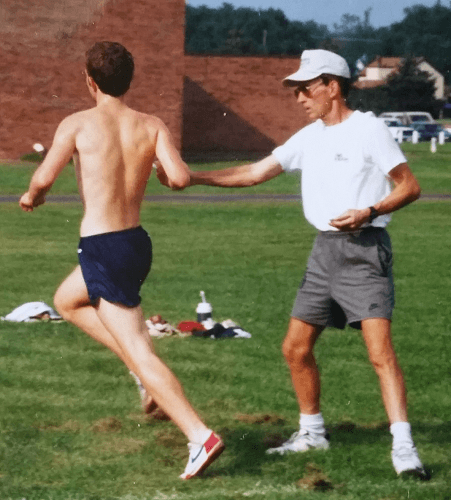
Coach Conway – inspiration, role model, mentor – working the finish line, one of the many jobs a high school coach fills

A personal post this week. As anyone who knows me as a runner knows, my middle school track and high school cross country coach has been a huge influence on my life. To be honest, he has been inside and outside of running.

To explain what Coach Conway has meant to me would take far more words than anyone wants to read in a blog post. To try to keep it short, I highly doubt I would have found my way to distance running without him and it’s no secret how big a part of my life running is. He has done much more for me, though. He taught me to be confident in myself, to be proud of what I’ve accomplished while remaining humble. He’s been an amazing role model on many levels, from the way he freely shares his incredible wealth of knowledge to his work ethic and desire to excel personally as well as be as helpful to as many others as possible.

Coach Conway’s accomplishments have rightfully garnered him many honors. As an athlete, he’s a member of the Indianhead Track Club Hall of Fame and the USATF Masters Hall of Fame (class of 2007). As a coach, he’s a member of the Wisconsin Cross Country Coaches Association Hall of Fame (class of 1998). I had the extreme honor of being his invited guest to the induction ceremony for the Wisconsin Cross Country Coaches Association Hall of Fame. I couldn’t have been more proud to sit there next to him as he was granted that honor, not just for coaching state champion athletes but also for coaching runners like me to be the best runners – and people – we can be.

Well, I just found out that Coach Conway is being inducted into another hall of fame. While he would likely never admit it, a lot of people who know him would agree with me that he can’t win enough of these honors. He deserves all he gets and many more.

Since hearing this news, I’ve been thinking about Coach Conway a lot again. How much he means to me and my life but also how many others out there have had their lives forever shaped in wonderful ways by his guidance. Coach Conway is the reason I started HillRunner.com, the reason I decided to take up coaching and the reason I do everything here. He gave me so much, in so many ways, through running that I wanted to do something to give a little back. I wanted to pay it forward in any way I could. If I can help even one person even half as much as he has helped me, I know I’ll have made this world a better place.

In the meantime, congratulations to Coach Conway! I couldn’t ask for a better inspiration, role model and mentor.

This week’s post is all about pain…???

This article was originally posted by Ryan at the original HillRunner.com Blogs.

I hope nobody gets the wrong impression. I really don’t think running should be such a painful thing. That said, I have two pain related topics for today. Gender specific injury prevention and our memories of painful events.

Gender specific injury prevention

This seems like an interesting topic to me. Let’s be honest. As much as I love the sport of running because it’s so open to all people, all ages, all genders, men and women are different even when it comes to running. There are some differences in our physiology that simply can not be overlooked.

How might those differences affect our susceptibility to injury? Well, Alex Hutchinson came across an interesting study on that topic.

Comparing within each sex, the injured female runners displayed greater hip rotation than healthy female runners. The same pattern didn’t show up in men, though; instead, injured male runners had greater ankle rotation than healthy males. So while the end result is the same, “females develop this injury from a hip-down perspective while men develop it from a foot-up perspective,” Ferber says.

Now, that’s an interesting result. The suggestion was that women should focus on hip strength to reduce injury risk while men should focus on foot and lower leg strength. I’d suggest that all runners should pay at least some attention to all these areas but it may be worth considering where an additional focus is given if you have a history of problems.

Our memory of pain

Think back to your last marathon. If you haven’t run a marathon, think back to your big race last year. What do you remember? The accomplishment? The sense of achievement you felt when you realized you hit your goal? Oh yeah, it hurt some also, didn’t it?

I suppose this shouldn’t be surprising but you probably have forgotten more about the pain than about the accomplishment.

In short, that’s exactly what happens. You remember the sense of accomplishment. The memory of the pain it took to get there fades.

What can we do with this? The article suggests trying to associate the pain during a race with the sense of accomplishment that is coming at the end because that’s what your future self will do. More practically, I’m not sure but it’s interesting to think about and I thought worth a share.

Haile Gebrselassie has retired from competitive running

This article was originally posted by Ryan at the original HillRunner.com Blogs.

Image

I will always remember both the ferociously competitive spirit and the huge smile

In case you haven’t already heard, the great Haile Gebrselassie has officially retired from competitive running. He says he will keep running and will remain involved in the sport but he is done competing.

As many runners of similar age, I grew up as a fan of running watching and cheering for Geb. Actually, I was split between Geb and Paul Tergat, his chief rival through most of the 1990s on the track and into the 2000s, first on the track and then in the marathon. Off the top of my head, I can’t think of a better two person rivalry in distance running history. Geb always seemed to have the upper hand but Tergat was always there From trading world records to the legendary 2000 Olympic 10,000 meter finish, they were always neck and neck.

Beyond the amazing competitions and times posted by Geb, though, I will also always remember that broad smile you can see in the image above. He always seemed to be friendly with everyone and truly love what he was doing. His enthusiasm for running and for the spirit of competition was amazing.

For all that you have done for the sport and for the great inspiration you have been for so many, thank you Geb. You are a true living legend.

Scroll to Top